Music journalism and gender equality are in the spotlight, focusing on the gatekeepers at significant music publications. Washington Post writer Monica Hesse recently stated:
Historically, artists have been considered excellent because certain gatekeepers have decided they are great.
(Monica Hesse, “Female rock legends not ‘articulate’ enough for Rolling Stone co-founder,” Washington Post, Sept. 15, 2023: online.)
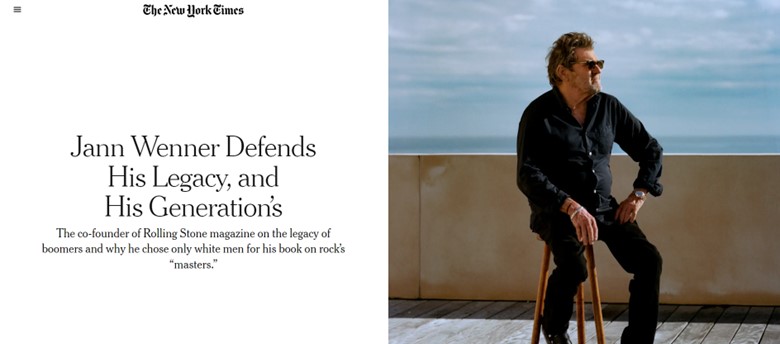
Hesse responded to the now-famous New York Times interview with Rolling Stone co-founder Jann Wenner, explaining why he excluded interviews with female and Black musicians in his new book, The Masters.

Wenner said these performers weren’t part of the “zeitgeist” of the time and weren’t “articulate enough” intellectually. The interview sparked a blowtorch of criticism. (David Marchese, “Jann Wenner Defends His Legacy, and His Generation’s,” New York Times, Sept. 15, 2023, online.)
The interview and the aftermath underscore why it’s time to interrogate music journalism’s history and how it’s fared on diversity, equity, and inclusion (DEI).
The Roots of the Controversy
The controversy triggered by Masters is part of a long line of critiques of Wenner and Rolling Stone dating back to Gone Crazy and Back Again by Robert Sam Anson. Published in 1981, the book chronicled Wenner’s rise from music tabloid editor to media superstar. The no-holds-barred account included statements by past employees who felt wronged by Wenner’s management style.

Anson’s narrative set the tone for two later books about Wenner and the magazine he co-founded. Rolling Stone Magazine: The Uncensored History by Robert Draper, and Sticky Fingers: The Life and Times of Jann Wenner and Rolling Stone Magazine, by Joe Hagan.


By the time Hagen’s book was released, rock fandom divided into anti-Wenner and pro-Wenner camps. But the debate set off by these books was about Wenner’s unconventional management style and mercurial disposition, not the lack of inclusivity at Rolling Stone.
Understandably, Wenner’s Times interview provoked commentary from both sides. This time, DEI issues were at the center. Although Wenner supporters condemned the despicable comments – which Wenner immediately apologized for – some felt the backlash was excessive, a piling-on by those already inclined to criticize Wenner.
But no one disputed the Times interview was a wake-up call to the pop music press to reflect on its legacy of exclusion and inequity.
Repercussion
The response to Wenner’s statements was immediate. First came Monica Hesse’s article in the Washington Post:
It’s fine to like what you like. But if you are Jann Wenner, a man who has been in the position to guide conversations about American pop culture for 50 years, how sad is it that it turns out that all of the musicians you find most worthy happen to be musicians who look like you?
And as a journalist, the most noteworthy part of all of this was that it didn’t seem to occur to him that maybe it’s him, he’s the problem. Had he never heard of Taylor Swift? That, if he found brilliant women’s answers to be boring, then perhaps he wasn’t asking the right questions.
That, if he understood “articulate” to mean one particular thing — a thing only embodied by White male artists — then maybe that, in itself, is a boring way to go about understanding music. That historically, artists have been considered excellent because certain gatekeepers have decided they are great.
Jann Wenner was one of those gatekeepers, shaping culture but also being shaped by culture — a product of his times, and a prisoner of his biases. A guy who had his finger on the pulse of culture in a certain era, when it was more acceptable for exclusively White men to be rock gods and exclusively White men to be their high priests.
This became a central claim – that racist, sexist, and homophobic values in the 60s shaped rock music and its journalism. A few days after Hesse’s article ran, the Rock ‘n’ Roll Hall of Fame removed Wenner from its board of directors. He had co-founded the organization and played a forceful, if controversial, role in selecting its candidates.
Soon after his removal, Wenner suffered another loss when he was sacked by Rolling Stone, another institution he co-founded.
Rolling Stone’s Response: “Where We Stand Now”

Two months after the Wenner Times interview, Rolling Stone published a special section devoted to the need for more diversity, equity, and inclusion in the music press, including itself. It was a collection of essays by the magazine’s staff members assuring readers that Rolling Stone would gather no moss in changing its ways. It’s an astonishing act of self-reflection that didn’t flinch from addressing the magazine’s past and present struggles with DEI.
Editor-in-chief Noah Shachtman titled the collection “Where We Stand Now.” He acknowledged that historically, RS had “two strains of thought. One reflected the “misogyny and racism” of the “founding era.” A second view, more inclusive, co-existed with this and became “dominant” in the late 2010s. But, he admits, “We’ve got work to do.” (Noah Shachtman, “Today’s Rolling Stone”)
The first essay declared, “This is About Accountability,” based on an article on the Black Rock Coalition website. The Rolling Stone essay credits the magazine for highlighting Black musicians over the years but found the coverage “more reactive than proactive.”
This isn’t about so-called cancel culture or political correctness. This is about failed cultural stewardship, which has been perpetuated for decades The narrative of rock as a white, straight, males only genre is antithetical to everything rock’n’roll represents. …
The reality is, the Jann Wenners of the world never gave Black excellence the consideration it demanded because it would have shattered the myth of this rock’n’roll thing of ours as, frankly, a white construct.

Breaking Through
In the next piece, “Breaking Through,” Althea Legaspi interviewed five prominent music critics. Each belonged to a group historically marginalized by the music press. Legaspi wrote:
Egregious racism and misogyny have a long history in rock and roll – from those on the industry side who have appropriated black artists – to those at the top of the publications who dictated what has been featured. The gatekeepers have always been a boys club – specifically a white boys club. … There’s still a lack of diversity across newsrooms. (Ibid)
Senior writer Brittany Spanos described her experiences at Rolling Stone:
The struggle was being alone. In a lot of respects, I was, for a long time, the only black woman who worked at the magazine and, for even longer, the only black woman writing full-time for both the magazine and the website. There are a lot of difficulties with that. It is hard to carry that weight and desire. To see more representation and more diversity in the coverage. You often feel tasked with doing that entirely on your own.
(Althea Legaspi, “Breaking Through”)
Yale professor Daphne Brooks said:
In my class, Black Arts Criticism, I want my students to understand something about the power, worth, and centrality of criticism across the generations being a form of knowledge production, and administering value to certain cultural objects and devaluing other cultural objects. … Cultural criticism is central to the Black-freedom struggle.
(Althea Legaspi, “Breaking Through”)
Time to kill the silence
The final essay was by Ernest Owens, a young Black queer journalist. Owens exclaimed, “It’s Time to Kill the Silence,” and said, “This is the mess Wenner’s legacy influenced: a media industry that has for too long neglected diversity, equity, inclusion.” He noted:
Representation matters and cultural accuracy should be paramount. … But while there’s been growth, there’s still more work to do … For far too long, silence has held this publication and society back from moving forward. Now is the time to stand up, tell the truth, and be loud.
(Ernest Owens, “It’s Time to Kill the Silence”)
Conclusion
The controversy over Jann Wenner and Rolling Stone magazine illustrates why it’s time to renegotiate the social role of music journalists.
Yes, despite Jann Wenner’s ill-chosen words, Rolling Stone, early on recognized the work of female and Black musicians. I saw this when I wrote The Life and Times of Ralph J. Gleason. My research included poring through every issue of Rolling Stone from 1967-75.
But White males have a responsibility to look past their preconceptions. To learn about the deeper realities of racism and sexism they haven’t directly experienced. For two decades, I have written about and taught African American culture. I learned as much as I shared with my predominantly Black students and colleagues during that time.
I’d love to hear from others on issues of diversity, equity, and inclusion in today’s music journalism. Contact me and let’s get a dialogue going!
© Don Armstrong, 2024
Subscribe and receive free posts like this in your mailbox twice a week:
Leave a Reply