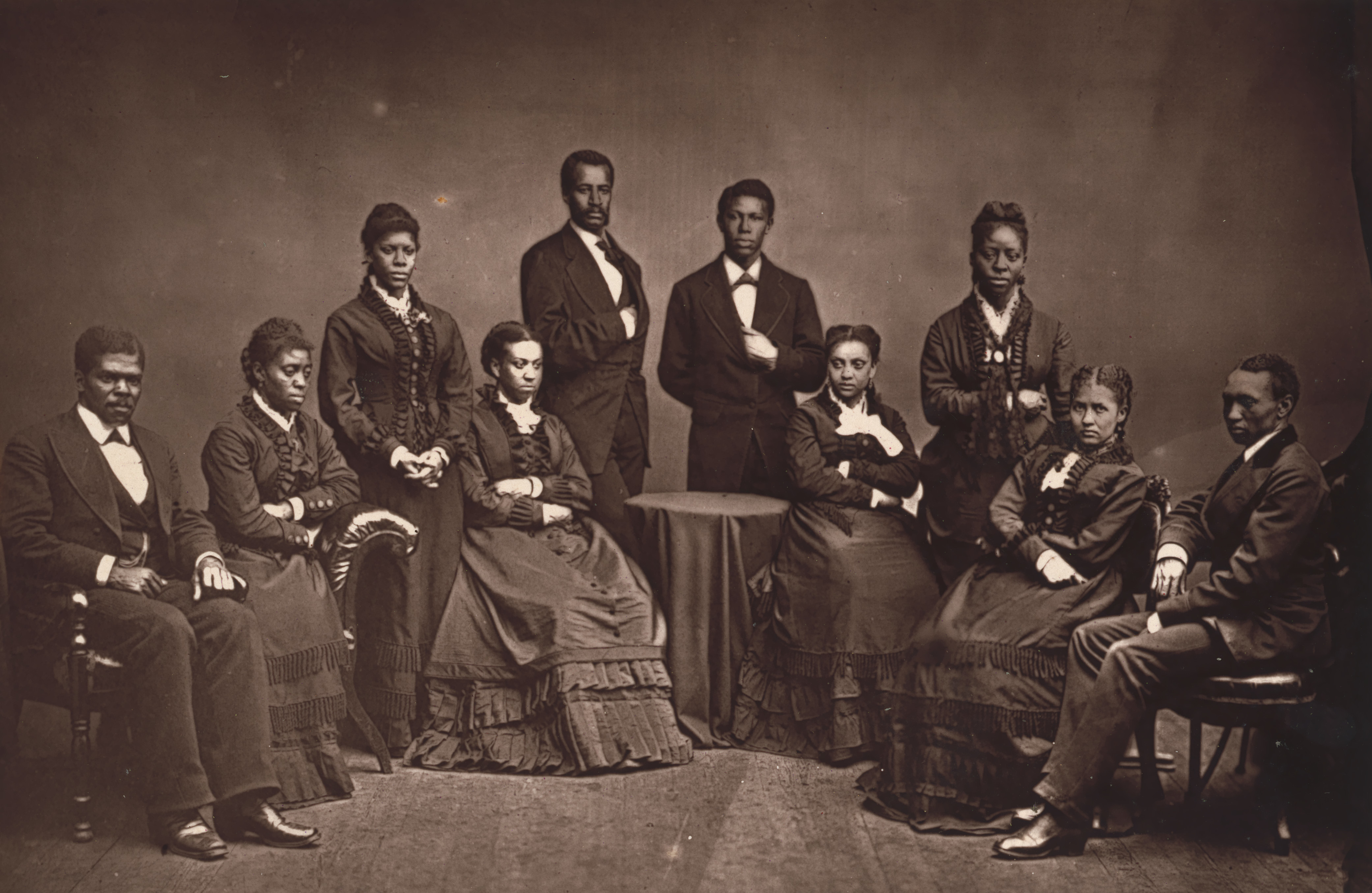
Music journalism in the post-Civil War Years covered a range of genres from minstrelsy to brass band marches. But one style of music inspired the most impassioned writings, spirituals:
Spirituals are a type of religious folksong that is most closely associated with the enslavement of African people in the American South. The songs proliferated in the last few decades of the eighteenth century leading up to the abolishment of legalized slavery in the 1860s.[i]
This definition comes from The Library of Congress Celebrates the Songs of America. As it notes, the origins of spirituals were in the everyday music of enslaved African Americans. Emancipation brought a new interest in this music from the press.
Journalists covered concerts by a cappella groups such as the Fisk Jubilee Singers and helped define spirituals as a music genre. As I discussed in my last post, the coverage of Black music at that time embodied the tangled attitudes toward race and music at a pivotal point in American history.
The earliest form of Black gospel music, spirituals gave voice to the joys and miseries of enslaved people. American journalists responded. Reporters attended concerts in their home cities and reported on the new “jubilee singers,” Black a cappella groups.
Feelings for Which There Was No Other Expression

African American orator Frederick Douglass recalled hearing enslaved workers sing on the Maryland plantation where he grew up:
While on their way, they would make the dense old woods, for miles around, reverberate with their wild songs, revealing at once the highest joy and the deepest sadness. They would compose and sing as they went along, consulting neither time nor tune … Into all of their songs they would manage to weave something of the Great House Farm. Especially would they do this, when leaving home. They would then sing most exultingly the following words:
“I am going away to the Great House Farm!
O, yea! O, yea! O!”
… I have sometimes thought that the mere hearing of those songs would do more to impress some minds with the horrible character of slavery than the reading of whole volumes of philosophy on the subject could do.[ii]

Among those whose minds were impressed were journalists. Take a look at this 1867 passage by an uncredited writer for the Brooklyn Union, a White abolitionist newspaper. The author reviewed the book Slave Songs of the United States:
Out of the South, there come to us sad voices of a time now gone forever… [These songs] can never again, thank God, be sung as slave songs. The earnest spirits that sought in their quaint, wild, and beautiful music the expression of feelings for which there was no other expression will never again be moved by like motives.[iii]
This unassuming news brief argued that spirituals expressed the Black experience like no other music, a claim that music critics would later make for genres from blues to jazz to rap in the years ahead.
Fisk Jubilee Singers
After emancipation, Black musicans formed a capella groups and performed sprituals in concerts. Leading the way was the Fisk Jubilee Singers. The chorus came together in 1871 to raise funds for Fisk University, a historically Black college in Nashville.
A reporter for the Hartford Courant took in a concert and had this to say:
The hall was crowded. All seats and standing room were occupied, while some went away, unable to get in. The enthusiasm with which these singers have been greeted at concerts was hardily shared by the large audience … The little contralto, Miss Tate, charmed everybody by her rendering of “Free as a Bird.”[v]

Historically black colleges and universities (HBCUs) such as Fisk provided access to a college education for African Americans during the era of school segregation. But these schools were initially controversial. Some Black leaders, including Frederick Douglass, believed that HBCUs stifled advancement towards integration.
The University Dodge
There was also White opposition to HBCUs, but for different reasons. This can be seen in an 1872 article in the Brooklyn Daily Eagle. The writer slammed the Fisk Singers for their association with a Black college. The article began innocently enough:
Negroes have a perfect right to be candidates for public favor as singers. As good a right as white people. It is sensible and lucrative, too, for them to announce that they will be heard to the best advantage in their dialect. Songs, glees, choruses, etcetera, or they will show their capacity for lyrical culture by attempting and effecting more ambitious music.
But then the writer accused the Singers of being a purely money-making ensemble that should be subject to the same critical scrutiny as for-profit musicians. A musical group that profited off the goodwill of naïve audiences. The writing drips poison:
… Many have withheld the expression of their criticism upon the singers and upon the gratuitous and slightly nauseous occupation by them of the churches which white people build and pay for in Brooklyn. The campaign of the darkies has been assiduously and cunningly conducted. The emancipation dodge, the ex-slave dodge, the university dodge, and the education and missionary dodge have been industriously worked up.[vi]
The writer even criticized Fisk for calling itself a “University” and urged Brooklyn donors to think twice before donating.
Southern Chivalry
But most journalists praised the Fisk Jubilee Singers:
The singers, as all know who have seen them, are bright and intelligent young ladies and gentlemen, quiet in demeanor, neat and clean in dress and habits, and altogether unexceptionable [nonoffensive] in conduct …
This passage illustrates a theme I’ve mentioned in earlier posts: the effort by pro-Black writers to assuage their readers’ racial anxieties. The journalist knew that, in 1875, many White readers held stereotypes about African Americans as being unintelligent and ill-mannered. And so, they point out that the Fisk Singers are just the opposite.
The writer notes that the White venue manager housed the entourage as his guests without “making the slightest distinction on account of color.” But when the chorus sat down for a Sunday luncheon amidst White diners, a group of Southerners reacted predictably:
All went well till Sunday noon when three drummers [salesmen] from Southern mercantile houses were thrown into a cold sweat by seeing 12 colored persons enter the dining room and take seats at one of the tables. The Southern heart was immediately fired. These three proud and lordly drummers at once mounted upon their high heels, stalked out into the office, paid their bills, and departed with empty stomachs, declaring that they “wouldn’t eat with niggers.”[vii]
However, the luncheon commenced in peace. Guests included senators, representatives, and other dignitaries who “ate a capital dinner in the company of the young ladies and gentlemen who had been the innocent cause of such a pleasing exhibition of Southern chivalry.”
Music journalism in the Post-civil War Years
The decade following the Civil War was a time of great dichotomies. Among these oppositions was the varying attitudes of journalists toward Black music.
Emancipation brought Black musicians a new autonomy. Drawing on the music of their people, these artists rescued plantation songs from the White minstrel troupes who parodied these tunes. In my next post, I’ll show how journalists responded to another form of emancipated music, Black minstrelsy.

Subscribe and receive free posts like this in your mailbox twice a week:
[i] The Library of Congress Celebrates the Songs of America, webpage: https://www.loc.gov/collections/songs-of-america/articles-and-essays/musical-styles/ritual-and-worship/spirituals/#:~:text=A%20spiritual%20is%20a%20type,legalized%20slavery%20in%20the%201860s.
[ii] Frederick Douglass, Narrative of the Life of Frederick Douglass, an American Slave (1845), Project Gutenberg eBook: 2006.
[iii] Uncredited, “Slave Songs,” Brooklyn Union Nov. 20, 1867: 3.
[iv] Uncredited, Wisconsin State Journal, Dec. 21, 1878: 2.
[v] Uncredited, Hartford Courant, February 15, 1872. Page 4.
[vi] Uncredited, The Fisk Jubilee Singers, Brooklyn Daily Eagle. February 24. 1872. page 2.
[vii] Uncredited, “Southern Chivalry Illustrated, Bucyrus Journal, February 26, 1875. Page 4.
Leave a Reply