Out in the street … another sound beckoned from down the street – loud rock music. A few steps in that direction, the rock music erased all other sounds. … there was a dance going on. This was clearly where it was at tonight. A 5-piece local band, the Young Bloods, was playing for the every-other-week dance staged by the Hudson Music Center’s Team Club.[i]
In his 1965 column, Minneapolis Star Tribune columnist Will Jones captured a universal phenomenon of the time: the birth of a city’s rock scene. Across the country, the sounds of electric guitars and thundering drums reverberated down city streets.
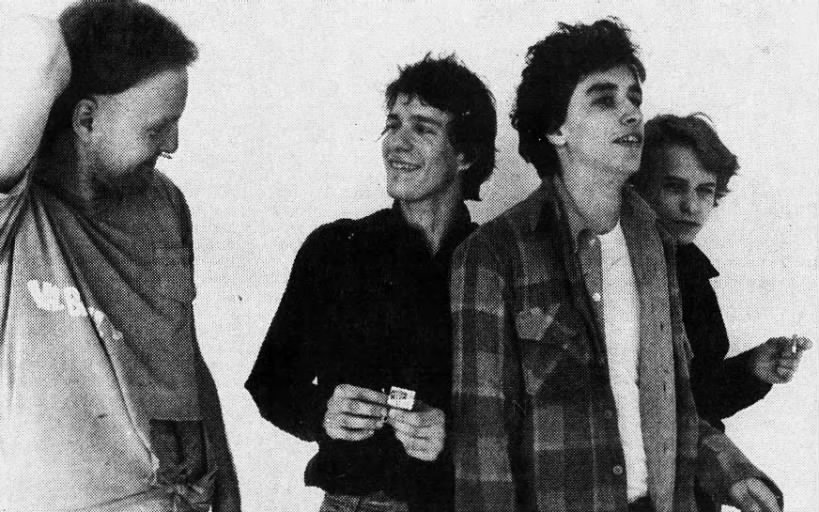
The Star Tribune nurtured Minneapolis’s rock scene from the 1960s to the alternative rock revolution of the 1980s. Out in the street, bands like the Replacements created a new style of deep-soul thrash that reshaped American popular music.
Birth of the Scene: 1965-75
The Minneapolis rock music scene evolved in the years following Beatlemania. Tribune music writers cultivated the community and its entrepreneurs.
Although the Twin Cities hosted significant rock bands in the 60s, Tribune journalists kept their eye on local rockers. For instance, a staff writer noted that the teen band Last Rites played a marathon session in their drummer’s basement that exceeded 100 hours. Hardcore permeated the spirit of Minneapolis rock from the start.
A 1967 article on the blossoming psychedelic rock scene shows the careful line that hip proprietors had to take between radiating the spirit of psychedelia and assuring the Establishment that nothing shady was happening. Journalists who were sympathetic to the counterculture, like Tribune staff writer Allan Holbert, shaped their articles accordingly:
An owner of a local head shop said, music on the phonograph… It’s hippie music not rock no one dances they just sit there. … People keep a close watch on psychedelia because they think some of the trips may be aided by dope. Owner Mike Kemp strongly denies any narcotics or sold or used in his place. [ii]
Tamping down homegrown moral panic was an essential role of journalists who supported psych rock scenes in the ’60s.

Jon Bream and the Start of the Alt-Rock Scene: 1975-80
Nothing promotes the health of a music scene like a supportive columnist – I discovered that while writing my biography of Ralph Gleason. When Jon Bream began writing the music review feature for the Star Tribune, the local rock scene gained a champion.

Bream had an ear for emergent non-commercial music. This can be seen in a summer 1977 column:
The most talked about trend of 1977 has been punk rock, the back-to-the-basics style rejuvenated in New York two years ago by street poet Patti Smith.
She still reigns as the Queen, while Lou Reed and John Cale, former members of The Velvet Underground, remain the genre’s gurus. But Tom Verlaine, leader of the group television, is the figure who will finally expand this movement’s artistic credibility beyond Smith.
The songs on Television’s debut album, Marquee Moon, seem to strive more for feeling than statement. The less-than-virtuosic quartet’s sound is uncluttered yet intricate, mesmerizing, and energetic. The words, which are closer to non-sequiturs and chants than linear thoughts, perfectly complement the eerie sound in such a way that the songs become powerfully moving.[iii]
Such articles surely whetted local rock fans’ tastes for punk and new wave sounds.

Bream zoomed in on Minneapolis musicians while covering records and shows by significant rock bands like Led Zeppelin. He began to devote columns to the city’s scene, supporting a new generation of punk-influenced bands:
The folk music scene that began to blossom in the early 1960s with Bob Dylan and Koerner, Ray and Glover still flourishes in local coffee houses. There is a wealth of local jazz musicians who can be heard regularly on the West Bank and other places. And dozens of rock and country musicians meet in basements, work out material and pretty soon find their way into one of the Twin Cities many bars and clubs.[iv]
With that, Bream provided a “comprehensive but not exhaustive guide to local rock bands.” However, most musicians stated their influences were traditional hard rock and prog.
Paul Westerberg is every kid
But punk began to influence the local scene by the early 80’s. A new sound was out in the street.
In the fall of 1981, Bream wrote another overview of the Minneapolis rock bands. He reviewed recordings by emergent Twin Cities bands. A 2-1/2 star review of the Replacements’ Sorry Ma, Forgot to Take Out the Trash was included. Bream wrote that the band “owes a lot to the spirit of the early Ramones. … The quartet plays and sings very well, especially considering the players’ youth….”[v]

Bream’s enthusiasm grew with each Mats album. He wrote that the music on Hootenanny “suggests the mesmerizing power and versatility of Paul Westerberg.”[vi] The following year, Bream wrote a profile of the band and wrote:
Paul Westerberg is every kid.
He looks like just about every kid looked or wanted to look at some time. Unkempt hair with a hint of peroxide, faded blue jeans rolled up at the ankles, comfortable black shirt, a cigarette dangling from his lips, a Scotch and water in his hand, forbidden eyeliner around his lashes.
Westerberg and the band were near the end of recording Tim, their first album for a major label. Westerberg, showing a vulnerability not associated with hardcore rock music, said:
This album is concentrating on songwriting more than just walls of noise. … We’re losing our inhibitions. We’re not afraid to do something that people might scoff at. When we started, we were afraid; we thought we’d hide behind sort of a wall of aggression. Now we’re softening it a little where we can do something that’s a little more sincere without being afraid that someone’s not going to like it or the punks aren’t going to be able to dance to it. [vii]
The songwriter said that the Replacements had tempered their onstage habits:
We used a tune for an hour on stage and drink two quarts of whiskey. Now we’re down to one quart and tuning for a half hour.
We don’t want to take ourselves too seriously – that’s the ultimate mistake. … We don’t have any goals or ambitions. Just to make it to next week.[viii]
The band did, week after week, for the next seven years. Then, after an extended hiatus, they returned strong with a second chapter of their gloriously shambling career.

Out in the Street
The Replacements were just one of many Minneapolis alt-rock bands out in the street during the 1980s. These artists benefited from coverage in the local media, especially the mass-circulation Star Tribune. This paper had excellent music writers, such as Jon Bream, who understood that music scenes were more than the sum of their parts. These milieus depend on information networks that bring the community together.
The Star Tribune and Jon Bream brought a legitimizing voice to the Minneapolis hardcore scene that catapulted it to national prominence.

[i] Will Jones, “Hudson Hops on Saturday,” Star Tribune, May 4th, 1965: 41.
[ii] Allan Holbert, “Teen Scene Includes Psychedelic,” Star Tribune, June 11, 1967: 85.
[iii] Jon Bream, “Pop Newcomers Show Impressive Talents,” Minneapolis Star Tribune, July 13, 1977: 6C.
[iv] Jon Bream, “Who’s Who Tunes in on the Local Rock Scene,” Minneapolis Star Tribune, Sept. 30, 1977: 1C.
[v] Jon Bream, “Local Groups Record Promising Sounds,” Minneapolis Star Tribune, Sept. 4, 1981: 4C.
[vi] Jon Bream, “Record Reviews,” Minneapolis Star Tribune, July 10, 1983.
[vii] Jon Bream, Minneapolis Star Tribune, Jan. 6, 1984: 3C.
[viii] Ibid.
Share:
Subscribe and receive free posts sent to your mailbox:
Leave a Reply