Introduction
Interviewer: What’s your attitude towards your audience?
James Chance: They are despicable.[i]
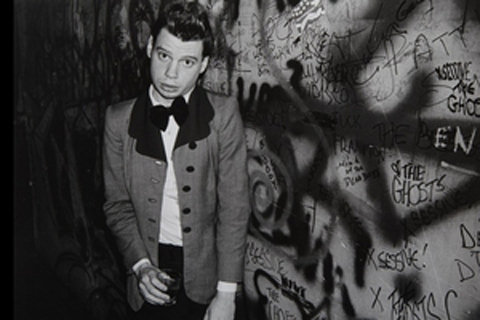
The recent passing of singer-saxophonist James Chance has reignited interest in his pioneering and controversial music. A leading figure in the New York no wave scene of the 1970s and 80s, Chance and his bands crafted a discordantly alive blend of jazz, rock, and funk that boldly challenged the conventions of rock aesthetics.
In Bernard Gendron’s excellent account of the New York no wave scene, he explained how Chance sought commercial success by bringing Black influences into new wave music despite the disinterest of the white rock critic establishment.[ii] However, how the music press impacted other aspects of Chance’s aesthetics is yet to be studied. This leaves a gap in our understanding of how critics mediate avant-garde rock music.
In this series of posts, I’ll demonstrate how critics in New York City and beyond played a pivotal role in reshaping the rules of rock discourse to effectively engage with the complexities of Chance’s challenging music and confrontational performance style.
In Part 1, I delve into the initial reactions to Chance’s music following his debut as James Chance and the Distortions. Critics such as Roy Trakin of the New York Rocker and John Rockwell of the New York Times, despite the deliberately unsettling nature of his work, took the untested performer seriously. I’ll illustrate how these early reviews and interviews contributed to the emergence of a no wave discourse, centered in New York, that reshaped the aesthetics of rock criticism.

No New York
James Chance arrived in New York City in 1975 and plunged into the punk scene. Within a year, he formed a band, Flaming Youth, and co-founded Teenage Jesus and the Jerks with the provocative singer Lydia Lunch. The emergent sounds of new wave music pounded from the city’s clubs, with CBGB a notable hub. A new tabloid called New York Rocker became the first rock magazine to use the term “new wave.”

However, a coterie of New York rockers who had dismissed punk as rehashed rock ‘n’ roll rejected new wave as too commercial. Bands like Teenage Jesus created a new genre of rock called no wave that incorporated aspects of performance art and avant-garde noise music.

James Chance and the Contortions emerged from this sonic uprising. The group performed at New York’s legendary No Wave music festival in 1978 and contributed to a compilation album, No New York, assembled by ambient rock musician Brian Eno.

Rock critic Roy Trakin reviewed the album in the January 1979 New York Rocker. He provided one of the first analyses of Chance’s music:
The Contortions’ music is based on an accented upbeat, syncopated, jazz-like rhythm, which has its roots in diverse styles ranging from Dixieland jazz to Captain Beefheart to reggae, to disco, to DEVO …
In other words, the band resisted categorization. And it tested the boundaries of popular taste:
James Chance’s Contortions, sometimes painfully incoherent live, click right into place from the opening grooves with a maniacally squawking Chance sax surrounding a relentlessly cyclical bass part. …
James Chance is a very provocative performer who acts out the discomforting, unfinished, offbeat meters of his frustration-causing music. The sentiments expressed in the lyrics are fragments of masochism, off-handed cliches, and erotic fantasies, all contributing to the dislocation brought on by the music. … The Contortions’ unique sensibility transforms jazz, R&B and soul into a sinister, murky stew.[iii]
Rock critics at the time used descriptors like “incoherent,” “maniacal,” and “discomforting” to criticize a musician’s style, not tacitly recommend it, as Trakin did. What did it mean for a critic to certify “frustration-causing” music?
Philosophy professor Gordon Graham has looked at the role of displeasure in the arts:
… people often employ terms sharply contrasted with pleasure. … Music can be used to alarm because human beings, somewhat surprisingly perhaps, can gain pleasure from activities that, at one level, are unpleasant… People enjoy being terrified.[iv]
And Chance devilishly exploited this side of human nature in his performances.

James Chance’s Performance Style: Challenging Them to Flail Back
Chance deliberately terrified his audiences with acts of violence. Different critics reacted differently to the hostile displays. For example, New York Times pop music critic John Rockwell wrote:
Physical violence is nothing new in rock, made most famous by Iggy and the Stooges in Iggy’s more flamboyant youth. But James Chance, the singer for the Contortions, has given to insulting his audience and striking out into the crowd, actually slapping as he goes. Sometimes he gets toughed back, which he seems to enjoy.[v]

A New York Daily News critic described Chance as “flailing his skinny body into the audience to challenge their composure or their boredom … but also challenging them to flail back.”[vi]
In the LA Times, Kristine McKenna wrote:
Chance became an instant celebrity when he began hurling himself into the catatonically polite audiences that were leaving him exasperated and disgusting. He expanded on his conceptualized disgust with occasional slaps at random audience members and suddenly found himself Gotham’s hottest, naughty sweetheart.[vii]
Other arts use psychological and physical violence as a tactic. For example, Antonin Artaud’s Theater of Cruelty sought to break down the barrier between the artist and the audience by disrupting the spectators’ complacency and involving them in the performance. Chance followed an existing tradition in the avant-garde.
However, critics disagreed on the effectiveness and safety of Chance’s physical altercations with audience members. Rockwell wrote:
Now, all of this might seem more pathological than musical or even sociological, except that the Contortions make very interesting music if the music were just a primitive onslaught. It would be easier to accept Chance’s act as the product of some drug-crazed irrationality – a primal scream against the world.
But because the music is clearly intelligent, rehearsed, thought through, and original, there is a strong assumption that Chances’ show of hostility is planned, too. The trouble – apart from the real possibility that Chance is going to get himself hurt by someone he provokes too far – is that such extreme anger is self-defeating.[viii]
But Chance took no heed, making statements like this:
I’d like to do a concentration camp show, done very modern, where I terrorize the audience with machines, pick out random audience members, and follow them with searchlights, for instance.[ix]
The New York Rocker Interview with James Chance
Chance could also aim his contempt at critics, such as his well-known attack on Robert Christgau. Another example was his contentious interview with New York Rocker’s Roy Trakin.[x] In it, Trakin admirably rolls with the punches to glean insights into Chance’s attitudes towards music and performing:
Roy Trakin: Is the saxophone the only instrument you play?
James Chance: No, but I don’t really wanna talk about that.
RT: How long have you been playing?
JC: What interest is that to anybody? Why would anybody care how long I’ve played the saxophone? …
RT: Listen, James, you’ve got to talk about something in this interview. You’ve got to reveal yourself a little to me. You were talking more when the recorder was off.
JC: It’s not a matter of revealing myself. You want me to get free publicity to these other people.
Undeterred, Trakin continued the questioning:
RT: I just want to know something about you, what your influences were growing up. Are you disaffected? Do you merely want to be part of the rock ‘n ‘ roll grist mill with your face in Creem and touring on the road 300 nights a year?
JC: I’d never tour two or three hundred nights a year. I’d be dead within a month. You gotta be crazy to do that.
RT: Do you feel part of the rock ‘n’ roll world at all? Are you comfortable in your role?
JC. I don’t feel comfortable anywhere. I don’t identify with any kind of group or anything like rock ‘n’ roll. That’s just another example of maudlin sentimentality, people having this big love affair with rock’ n ‘roll. I have nothing to do with rock ‘n ‘roll.
RT: That’s pretty irreverent.
JC: Not even irreverent. If you’re irreverent, it means you have a need to be reverent. …
RT: Why is your music so frustrating, so tension producing?
JC: Well, partly because my band is usually pretty fucked up when we go on stage. It isn’t meant to make you feel good. Those people don’t deserve to feel good. They should feel nothing but a heel sticking in their mouths, grinding away …
RT: When you’re in a group of people, do you feel you’re a negative influence? Do you make people feel uncomfortable?
JC: I certainly hope so. When I start making people feel comfortable is when I start to worry.
RT: That’s truly perverse.
JC: How can anyone be interesting when they’re comfortable? When they’re comfortable, they’re just vegetating and getting fat! …
RT: Are you going to follow up the release of No New York by appearing in other cities?
JC: I think that’s enough of this interview already, that’s pretty much. You’ve got enough.
RT: You don’t want to do anymore?
JC: NO.
Conclusion
With that, the interview ended. We can only imagine what it was like for Trakin to endure a non-stop stream of insults and provocations. Some of Chance’s responses were vile and tossed around racist and homophonic slurs designed to provoke the interviewer. In addition, quotes from Chance about how he forced audiences to listen to the unlistenable.
Yet, those quotes and others like them became part of the emergent discourse of no wave. Left to stand for the reader to interpret. This discourse constructed a novel view of avant-garde rock as a radically unsettling force. Although occurring on the periphery of mainstream music, no wave prompted a turning point in music journalism because it redefined what it meant to take pleasure from pop music. In the following posts, I’ll continue to trace the co-development of Chance’s confounding music and its criticism.

[i] Roy Trakin, “James Chance,” New York Rocker, Jan. 1979: 16.
[ii] Bernard Gendron, Between Montmartre and the Mudd Club: Popular Music and the Avant-Garde (University of Chicago Press, 2002): 284-88.
[iii] Roy Trakin, “Getting to No You: No New York on Record,” New York Rocker, Jan. 1979: 13.
[iv] Gordon Graham, Philosophy of the Arts: An Introduction to Aesthetics, Routledge, 1997: 66.
[v] John Rockwell, “Hostile Rock ‘n’ Roll Has Become Normal,” Lincoln Journal Star, Jan. 4, 1979:10.
[vi] Ernest Leogrande, “The Contortions,” Daily News, Dec. 10, 1979:45.
[vii] Kristine McKenna, “Leaving Nothing to Chance,” Los Angeles Times, Feb. 10, 1980: 416.
[viii] John Rockwell, “Hostile Rock ‘n’ Roll Has Become Normal,” Lincoln Journal Star, Jan. 4, 1979:10.
[ix] Kristine McKenna, “Leaving Nothing to Chance,” Los Angeles Times, Feb. 10, 1980: 416.
[x] Roy Trakin, “James Chance,” New York Rocker, Jan. 1979: 14-16.
Don’t forget to check out my my book, The Life and Writings of Ralph J. Gleason.
Share:
Subscribe and receive free posts sent to your mailbox:
Leave a Reply