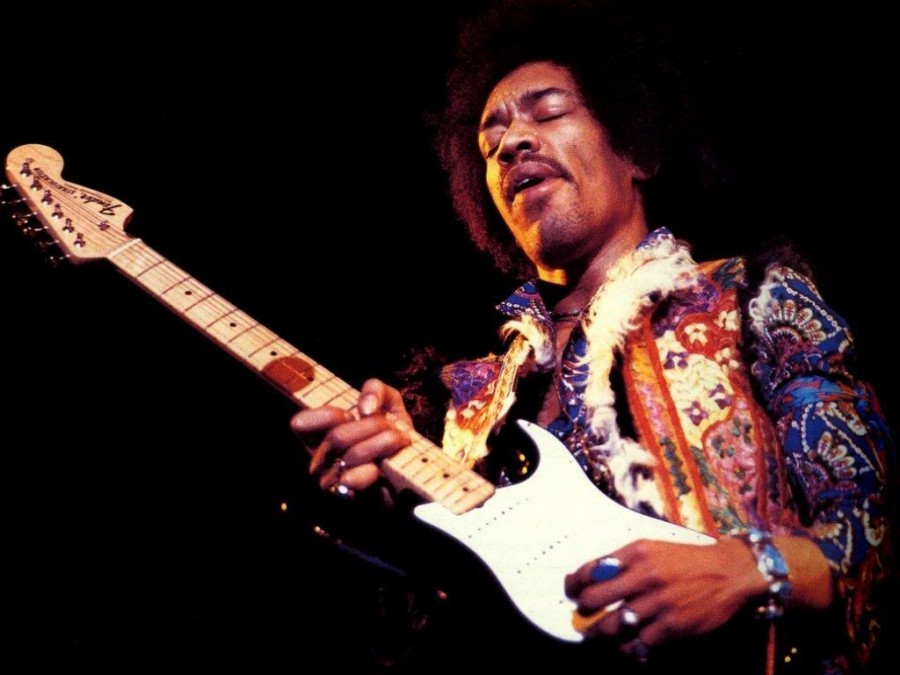
Ralph J. Gleason on Jimi Hendrix
Greetings!
My interest in writing this post stemmed from research on Jimi Hendrix for my book The Life and Writings of Ralph J. Gleason. Gleason wrote about Hendrix for his influential music column for the San Francisco Chronicle. As I detail in my book, Gleason’s perspective on Hendrix shifted significantly from the Monterey Pop Festival to the Bay Area ballroom scene that followed.
I show in my book how Gleason was captivated by the intersection of blues-rock and race. He wrote insightful articles about the Black blues musicians who influenced Hendrix, particularly T-Bone Walker. In the 1960s, Gleason was one of the first music critics to support the psychedelic rock culture that Hendrix helped energize.
As a rebellious young writer in the 1930s, Gleason produced some of the first reviews of guitarist Django Reinhardt, often regarded as the Hendrix of his day due to his fiery improvisations. As I detail in my book, by the time Gleason began writing about Hendrix, he had already chronicled concerts and records by revolutionary Black electric guitarists who preceded Hendrix, such as Charlie Christian, Sister Rosetta Tharpe, Chuck Berry, and B.B. King. This background gave Gleason an unparalleled ability to contextualize Hendrix and other rock guitarists within a rich historical framework.
Fans of Jimi Hendrix and rock guitar will find The Life and Writings of Ralph Gleason engrossing, as it transports readers into the concerts and behind-the-scenes action of a remarkable era in rock music history. Check it out!
Now, let’s take a deeper look at how the UK press shaped the image of the most talked-about rock guitarist of the 1960s.
Introduction
Jimi Hendrix might have achieved superstardom without press coverage due to his groundbreaking musical talent and captivating stage presence. However, British journalists played a crucial role in transforming Hendrix from a local guitar hero into a global sensation. In particular, these writers highlighted Hendrix’s stage show and appearance.
These journalists also emphasized Hendrix’s roots in the American Chitlin’ Circuit. They noted how his stage appearance contrasted with the typical image of Black R&B singers with their slick suits and pompadours. A picture of Hendrix emerged as a young Black artist forging his own identity within the expansive psychedelic rock scene.
Free Feeling
In the summer of 1966, months before the British press caught wind of Hendrix, the guitarist quit his career as an R&B sideman. He moved to Greenwich Village, where a vibrant, blues-influenced psychedelic rock scene blossomed. Hendrix formed a new band, Jimmy James and the Blues Flames. The band played New York rock clubs such as the Cafe Wha?
Hendrix’s virtuosity came to the attention of Chas Chandler, the bassist for the Animals. Chandler, who left the Animals to become a talent scout, brought Hendrix to London to manage his career. He had Hendrix form a new band, the Jimi Hendrix Experience.
Soon, the band astounded audiences at London clubs such as the Bag O’Nails. There, the editor of Record Mirror, a top British music magazine, heard Hendrix and granted him his first interview. The writer, Peter Jones, wrote:
Jimi was in full flight. Whirling like a demon, swirling his guitar every which-away, this 20-year-old (looking rather like James Brown) was quite amazing. Visually, he grabs the eyeballs with his techniques of playing the guitar with his teeth, his elbow, rubbing it across the stage . . . but he also pleasurably hammers the eardrums with his expert playing. An astonishing technique . . . especially considering he started playing only 5 or 6 years ago.[i]
In the interview, Hendrix said:
I’ve only been in London three months – but Britain is really groovy. Just been working in Paris and Munich.
We don’t want to be classed in any category. If it must have a tag, I’d like it to be called “Free Feeling.” It’s a mixture of rock, freak-out, blues, and rave music.[ii]
“Hey Joe”
Six days after the article ran, Hendrix released his first British record, “Hey Joe,” backed with “Stone Free.” Two television appearances followed this. The single entered the UK charts and began to rise.
As a result, England’s top pop music critics began covering Hendrix. Like Jones, they extolled Hendrix’s showmanship. For example, Chris Welch of Melody Maker wrote:
Jimi has great stage presence and an exceptional guitar technique which involved playing with his teeth on occasions and no hands at all on others! Jimi looks like becoming one of the big club names of ’67.[iii]
Keith Altham of New Musical Express (NME) wrote:
Hendrix is a one-man guitar explosion with a stage act which leaves those who think pop has gone pretty with their mouths hanging open. What this man does to a guitar could get him arrested for assault.[iv]
Many fans thought that pop music had “gone pretty.” The hard-edged sounds of early, blues-based rock’n’roll had softened during the folk-rock period. The enormous success of the Monkees demonstrated that record companies could profitably create successful rock bands as long as they maintained safe images.
Yeah, I’ll Gig
In contrast, Hendrix came up through the gritty conditions of the Chitlin’ Circuit. Altham let Hendrix paint the picture:
“One of the Isley Brothers heard me playing in a club and said he had a job open. Sleeping between them tall tenements was hell – rats running across your chest, cockroaches stealing your last candybar, so I figured, ‘Yeah, I’ll gig’ …
“In Atlanta I auditioned with Little Richard, topped the gig and worked with him all over the U.S. – finally landing in Los Angeles, and playing more gigs with Ike and Tina Turner.

Hendrix said that after giving up the circuit and moving to New York,
“I got a job with another band. I had all these ideas and sounds in my brain, and playing this ‘other people’s music’ all the time was hurting me.”[v]
Mr. Phenomenon
A few weeks after NME ran Altham’s article, British music journalists picked up Hendrix’s story.
One of the first was Alan Jones, who wrote a pop music column for the Lincolnshire Echo, a regional weekly. Referring to Hendrix, Jones wrote:
London’s gone potty about him. Beat club managements are queuing to book the shaggy-haired young Negro blues singer dubbed “Mr. Phenomenon.”[vi]
The two-month-old Experience is widening their appeal. At the time that the clean-cut image of the Monkees is taking the pop business by storm, the experience’s rugged sound is making a heavy impression on the British pop charts.[vii]
Asked about the sudden attention, Hendrix “dipped his head and groaned,”
“Oh God. I don’t know. I can’t believe it’s happening.
Most people believe that to be a good blues musician, one has to suffer. I don’t believe this. I just like the sound of the blues. When I hear certain notes I feel real happy …
I feel embarrassed when I hear a compere [announcer] giving me a big build-up before I go on stage, or I see my name and lights outside a theater. I can’t believe it is happening to me.”[viii]
Raised Eyebrows
Jones then went on to describe Hendrix’s appearance:
Offstage, Jimi wears trendy ceremonial army tunics and purple silk shirts, reads science fiction, likes Beardsley drawings, and enjoys painting abstract landscapes.
It is his appearance that has raised eyebrows.
At a recent television show, cameramen asked “What’s that?” when Jimi stepped before the cameras wearing black silk shirt, black bell-bottom trousers, high boots and an embroidered gold lame waistcoat.

Jones added:
Jimi has rejected the accepted image of the Negro artist – processed hair, slick silk suits and rehearsed, rather stereotyped dancing on the stage.[ix]
Hendrix responded, “The comments don’t bother me. I don’t feel any hate for anybody.”[x] Asked if he’d experienced any racial prejudice, he replied,
When I was younger, I would stand on one side of a street in Nashville and shout at the white people and they would shout at us. It happened every week.[xi]
Hendrix told Jones that he missed being on the road:
I can’t stay in one place too long. I have to move on. I don’t know why.
I’m scared. Scared of – what’s the word?– vegetating. There’s so much to see and places to go. I wish I could travel all the time. I don’t know how long I will be here.[xii]
A poignant comment, given his untimely death.
Jones ended the article by saying:
Surprised or not, Jimi’s earthy style is the pop talk of the moment. But for how long, it is hard to hazard a guess.
Remember the Cream?[xiii]
Purple Haze
That comment referred to the fact that it had been seven months since the power trio released Fresh Cream. Disraeli Gears wouldn’t drop for three months, in May 1967. Fans of high-energy blues-rock grew impatient.
But Hendrix and Chandler weren’t going to let Hendrix be a one-hit wonder. Track Records released their second single, “Purple Haze.” The press responded.
One of the first to review the disc was Tony Barrow, the Beatles’ press officer who also wrote a music column for the Liverpool Echo. Barrow wrote:
The Jimi Hendrix Experience burst upon the scene very recently but their lively personal appearances and their first hit single have brought them fame. Next Friday they release a new single on a new label. The title is “Purple Haze,” and the label to look for is known as Track Records.
“Purple Haze” gathers together as much as it can of the astounding Hendrix excitement, everything which can transfer from live performance to record. Prepare to have your ears battered and intolerably by his rough-edged storm of sound. You can’t enjoy a disc such as this, but you can feel exhilarated mentally, if not physically, by its power and its weight.[xiv]
This was an honest assessment from the middle-aged hot jazz fan who brought the Merseybeat to the world. Barrow’s words show how shocking the first sounds of heavy metal were in 1967. Barrow echoed critic Ralph J. Gleason’s statement that one went to rock shows to experience the music, not to listen to it conventionally.
Walker Brothers Tour
Two weeks after that, the Jimi Hendrix Experience embarked on their first UK tour. The Walker Brothers headlined a package that included artists such as Cat Stevens and Engelbert Humperdinck.

The tour MC was Nick Jones, a young writer at Melody Maker with an interesting pedigree. Jones was the son of pioneering jazz critic Max Jones, who had introduced Jann Wenner to Swinging London the previous summer. When Wenner later founded Rolling Stone, he made Nick Jones his informal “London Correspondent.”
Thus, when Hendrix joined the Walker Brothers tour, he came to the attention of rising British rock critics like Jones.
British newspapers, such as the Lincolnshire Echo, covered the tour. One article painted a vivid picture of Hendrix:
A great guy on and off stage, Jimi Hendrix was in very bouncy mood. His opening remark was: “I am going to put a curse on everyone so that all their babies are born naked.” A remark which he obviously thought had some deep significance.
He was wearing turquoise trousers and an old-fashioned military jacket trimmed with silver braid and fur. “When I was 6, my grandmother gave me a Spanish jacket covered with baubles, and ever since I’ve loved funky clothes,” he explained.
He described his clothes as “freak and funky” and his wild music as a touch of blues, jazz and rock. He also agreed that some of his music was psychedelic – no real beat and a sound in which the imagination of the audience plays a large part.[xv]
Magnificent Rock Blues
May 1967 was a turning point for the Jimi Hendrix Experience. They released their third single, “The Wind Cries Mary,” followed by their debut album, Are You Experienced.
The album received one of its first reviews by Richard Williams, a journalist from the Nottingham Guardian Journal. Williams was yet another rising British critic destined for bigger things. A few years later, he would edit Melody Maker, enhancing its status as a source of serious rock criticism.
But in spring 1967, Williams paid his dues at the Journal, covering pop music. Not surprisingly, his review of “The Wind Cries Mary” was point-on:
Here is the ultimate proof, as if we needed any, that Hendrix is the most creative musician in Britain today. The only thing it retains from his past singles is the basic, earthy, street musician feel, which is here injected into a relaxed number with surrealist, Dylanesque words. Jimi’s guitar is softer than usual, but still constantly surprises and occasionally electrifies. The flip, “Highway Chile,” is a magnificent piece of rock blues.[xvi]
A Cauldron of Beautiful Fire
A week later, Melody Maker reviewed Are You Experienced. The reviewer? Nick Jones, fresh off hosting the Walker Brothers tour featuring Hendrix. Jones wrote:
Yes — this is the real Jimi Hendrix
One of the most pleasing aspects of Jimi Hendrix’s success is his refusal to be blatantly “commercial.” … Subsequently, we’re getting the real Hendrix on this album …
Throughout Jimi, Mitch on the skins, and Noel on leaping bass, thunder and charge along at some hammering tempos. They change speed mid-number; stop, start, fade, fizzle, simmer, and burn in a cauldron of beautiful fire. Hendrix is in soaring guitar form, and with the help of producer Chas Chandler, they come up with some extremely atmospheric, organic sounds which have an uncanny knack of circling through the mind and blowing the top of your head off.[xvii]

Are You Experienced climbed to number two on the UK record charts, blocked from number one by the Beatles’ Sgt. Pepper’s Lonely Hearts Club Band. But the album didn’t immediately garner attention in the U.S.
Monterey Pop
That changed after Hendrix gave a history-making performance at the Monterey Pop Festival. The stunning show prompted Reprise Records to release Are You Experienced in America. The album made the Top Ten and remained on the charts for two years. The disc’s sounds electrified the counterculture of the 1960s.
Hendrix went on to deconstruct the landscape of modern rock music. He expanded the vocabulary of the electric guitar with a dazzling array of new sounds. Hendrix’s roots in Black blues and R&B allowed him to surpass white hard-rock imitators.
Hendrix continued to dominate the rock press from the late 1960s until his untimely death in 1970. He became the muse of photojournalists such as Jim Marshall. In photographs and words, the spirit of Jimi Hendrix lives on to inspire us today.
Conclusion
It’s difficult to imagine the golden days of rock journalism without Jimi Hendrix. Cover stories abounded, and each new release of a Hendrix album prompted lengthy reviews by the top critics of the day.
But some American rock critics tended to be harsh in their assessments. Rolling Stone magazine is known for initially dismissing Hendrix as an over-hyped showman while acknowledging a few moments of genius. A few critics from other publications shared a similar view in their articles.
Some of those articles, as well as several included in this post, racialized Hendrix’s style. A few reviewers tossed around the derogatory term “Super-Spade,” as though it gave them hipster credibility.
However, when Hendrix died in the fall of 1970, Rolling Stone devoted its cover and six tabloid-sized pages of photos and words to the fallen guitarist.

The remembrance culminated in an article by contributing editor John Burks. Although not free of the white-hipster racialized characterizations of his peers, Burks’ remembrance ended with a powerful account of one of the most memorable performances in rock history, Hendrix’s Woodstock performance of the national anthem:
The sound of the rockets’ red glare as interpreted by Jimi Hendrix is as violent as any in contemporary music. And so is the long, keening, descending note he plays at the end of the phrase “Land of the freeeeeee-eeee-eeeee” – like a scream of Black rage. And then a taste of “Purple Haze.” And then a quick shift to a lonely, intensely dignified closing statement, Hendrix playing with great tenderness and romanticism and strength, like a 1969 Django Reinhardt …
There will never be another like him.[xviii]
Notes
[i] Peter Jones. “Mr. Phenomenon!” Record Mirror, Dec. 10, 1966: 2.
[ii] Peter Jones. “Mr. Phenomenon!” Record Mirror, Dec. 10, 1966: 2.
[iii] Chris Welch. “Jimi Hendrix Experience: Blaises, London,” Melody Maker, December 31, 1966.
[iv] Keith Altham. “New To The Charts: Wild Jimi Hendrix,” New Musical Express, Jan. 14, 1967.
[v] Keith Altham. “New To The Charts: Wild Jimi Hendrix,” New Musical Express, Jan. 14, 1967.
[vi] Alan Jones. “Beat Clubs Queue to Book Him,” Lincolnshire Echo, Feb. 6, 1967: 6.
[vii] Alan Jones. “Beat Clubs Queue to Book Him,” Lincolnshire Echo, Feb. 6, 1967: 6.
[viii] Alan Jones. “Beat Clubs Queue to Book Him,” Lincolnshire Echo, Feb. 6, 1967: 6.
[ix] Alan Jones. “Beat Clubs Queue to Book Him,” Lincolnshire Echo, Feb. 6, 1967: 6.
[x] Alan Jones. “Beat Clubs Queue to Book Him,” Lincolnshire Echo, Feb. 6, 1967: 6.
[xi] Alan Jones. “Beat Clubs Queue to Book Him,” Lincolnshire Echo, Feb. 6, 1967: 6.
[xii] Alan Jones. “Beat Clubs Queue to Book Him,” Lincolnshire Echo, Feb. 6, 1967: 6.
[xiii] Alan Jones. “Beat Clubs Queue to Book Him,” Lincolnshire Echo, Feb. 6, 1967: 6.
[xiv] Disker [Tony Barrow]. Liverpool Echo, March 11, 1967: 8.
[xv] Uncredited. “Pop Tours ‘Play-Out – Walker Brothers,” Lincolnshire Echo, April 21, 1967: 5.
[xvi] Richard Williams, “New Releases,” Nottingham Guardian Journal, May 13, 1967: 5.
[xvii] Nick Jones. “Jimi Hendrix Experience: Are You Experienced?” Melody Maker, May 20, 1967.
[xviii] John Burks. “An Appreciation,” Rolling Stone, Oct. 15, 1970: 9.
Leave a Reply