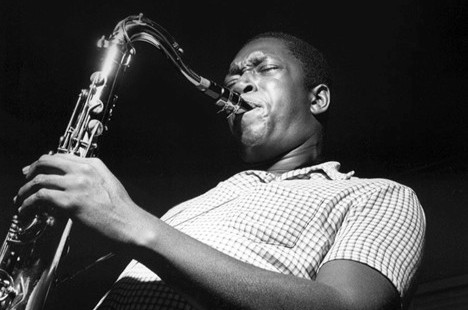
In 1965, Phyl Garland, music columnist for the Pittsburgh Courier, wrote of John Coltrane and other free jazz innovators:
Experimentation and the constant seeking of New Horizons is a healthy thing in any art. It has always played an important part in jazz and has not been unrelated to the temper of the times in which the form developed.[i]
Music journalism also expresses the “temper of its times,” as this post explores.
Scribe & Muse: Ralph J. Gleason and John Coltrane
In writing The Life and Writings of Ralph J. Gleason, I came away with a far more expansive view of John Coltrane and his contribution to American music.
As I detail in my book, Gleason watched Coltrane evolve from sideman to bandleader. He and Coltrane became friends, and Gleason’s interviews and reviews of the saxophonist are key texts in the literature of jazz writing. As I show in my book, these kinds of personal relationships with musicians led Gleason to see upcoming changes in jazz as foretold by the musicians driving those changes.

Gleason first saw Coltrane perform at the Blackhawk nightclub in San Francisco in 1956. As the jazz critic for the Chronicle, Gleason witnessed the role played by that club in nurturing modern jazz. By 1961, Gleason had covered Coltrane’s rise and recognized his greatness.
In my book, I take the reader into Gleason’s fabled living room – lined with record albums, books, and ephemera – where he heard Coltrane’s plans for a new direction in his music. That same year, 1961, Gleason wrote a fateful article in DownBeat magazine comparing Coltrane’s innovations to the “winds of change” sweeping away global colonialism. As I show, this turn to politically charged commentary brought Gleason to a turning point in his career.
However, his relationship with Coltrane deepened. Gleason featured him on his public television show Jazz Casual. He wrote the liner notes for a Coltrane album. And, of course, Gleason wrote some of the most insightful reviews of Coltrane’s performances and records as the sax player opened up new directions in jazz.
With that, let’s take a look at how journalists depicted Coltrane’s evolution from the 1940s to the 1960s in the African American newspaper, the Pittsburgh Courier. Their perspectives may surprise you.
Introduction
Saxophonist John Coltrane transformed jazz in the 1950s and 1960s. As a restless experimenter, he pushed beyond the hard bop style of his earlier recordings and pioneered a bold new direction while performing with the Miles Davis band. This innovative sound became known as “modal jazz,” which relied on modes (scales) instead of traditional chord changes to define a performance. This approach allowed musicians greater freedom in both improvisation and composition.
John Coltrane showcased the potential of modal jazz in his masterpiece, A Love Supreme, released in January 1965. Within months, it became one of the most acclaimed albums in jazz history. However, the mainstream media largely overlooked Coltrane, despite being one of America’s pioneering musicians.
The African American press, on the other hand, recognized Coltrane’s talent early on. Starting in the postwar years, Black newspapers like the Pittsburgh Courier documented Coltrane’s journey from sideman to bandleader. After A Love Supreme was released, one particular Courier writer wrote an uncommonly insightful column about Coltrane’s difficult entrée into avant-garde jazz.
Indeed, Black writers at the Pittsburgh Courier made an essential yet unrecognized contribution to the literature about Coltrane. The Courier texts documented the ceaseless experimentation of one of America’s most outstanding jazz musicians, John Coltrane.
Consumed by Bird
Coltrane was born in North Carolina in 1926, where he grew up. His family moved to Philadelphia in 1943, part of the northern migration of Southern Blacks during the Jim Crow era.
That year, Coltrane’s mother bought him an alto saxophone, and after two years of lessons, he began playing professionally in a trio. It was at that time that Coltrane first heard iconic alto saxophonist Charlie “Yardbird” Parker:
When I had first heard Bird, I wanted to be identified with him, to be consumed by him. But underneath, I really wanted to be myself.[ii]
But before Coltrane began that search, he enlisted in the Navy. Stationed in Pearl Harbor after the Japanese bombed it, Coltrane developed his skills within a swing band on the base. After being discharged, he studied music and played in the Philadelphia jazz scene.
In 1947, he joined the jump blues band of Eddie “Cleanhead” Vinson, named for his bald head, caused by a hair product containing lye. Coltrane switched to tenor saxophone, which opened him up to a new circle of influences, namely bebop innovators Lester Young and Coleman Hawkins.
During his tenure in the Vinson band in the late 1940s, John Coltrane received what was likely his first press coverage, as part of a new lineup of young musicians in Vinson’s group. One of these news briefs ran in Pittsburgh’s African American newspaper, the Courier. The article was playfully entitled, “Youth will Have Its Fling with Mr. Cleanhead”:
Adhering to the ancient belief that “youth shall lead them,” Eddie Vinson, blues singing sax maestro, is reorganizing his band around young men, none over twenty-four years old.
The new “kid combo” includes … John Coltrane.[iii]

Major Black newspapers around the country ran the article and similar ones. It appears no white newspapers did. This confirms that there was a lot of great music happening at that time that white readers missed out on. It also demonstrates the greater interest in Black jazz and pop by African American newspapers.
The Courier
That interest went deeper than merely reflecting the tastes of Black music lovers. During the Jim Crow era, these newspapers were a primary source of expression for the community’s pride in its musicians.
Also, Black periodicals understood the challenges these musicians faced, from segregated clubs and hotels to unequal treatment by the music industry and media. Newspapers such as the Pittsburgh Courier, which routinely published articles and opinion pieces about inequality and violence against Blacks, also spoke out against discrimination in the music business. As noted, these publications also took pride in featuring successful Black musicians.
The Courier, like a number of African American newspapers around the country, was published in its city’s Black district. Pittsburgh’s Hill District hosted a longstanding and bustling jazz scene.
In fact, it was in the Hill District that the Pittsburgh Courier launched as a small weekly in 1907. In time, the Courier grew into one of the country’s leading African American newspapers. From the start, the Courier exposed discrimination and fought segregation.
It also covered popular music in its entertainment pages. By the 1920s, the Courier covered jazz musicians such as Duke Ellington. Thus, its first article referencing John Coltrane was part of a lineage of jazz coverage dating back decades.

Tenor Madness
After the news briefs went out about the Eddie Vinson band, Coltrane used his new status to find work with leading bandleaders such as Johnny Hodges and Dizzy Gillespie. As bebop waned in the early 1950s, cool jazz became the genre’s dominant idiom.
But some musicians, such as Coltrane, took their music in a different direction that came to be called hard bop. It was more accessible than bebop or cool, influenced by blues, gospel, and R&B. Coltrane became one of hard bop’s innovators and became a sought-after session musician. He played on essential recordings, which garnered further attention in the Black press, including the Courier. This can be seen in their 1956 review of Tenor Madness by Sonny Rollins, featuring Coltrane:
As long as guys like Sonny and “Trane” are around, the tenor sax will never fall under the pall of lost art … The group plays “Tenor Madness,” where Rollins and the “Trane” chase each other around for a good 10 or 12 minutes.[iv]
This capsule review appeared in the Courier’s new record review column, “Data ‘Bout Discs,” written by Harold L. Keith. He started at the paper in 1946 and wrote the column on the side while reporting major stories and helping edit. His obituary read:
Mr. Keith was best known for his prescient articles and commentary on Africa during a period when independent states were beginning to emerge on that continent. He also foresaw the role organized labor could play in furthering the modern civil rights movement.[v]
A few months later, Keith reviewed a disc featuring Coltrane and pianist-composer Tadd Dameron, called Mating Call. Keith wrote:
Coltrane displays a wail that is undistorted by the moving composition of Tadd Dameron, whose artistry has been missing too long from the houses of wax … Tadd and Coltrane collaborate on five compositions which highlight the pure tonal effects of the “Trane’s” horn …[vi]
Keith wrote in a concise style that clearly expressed his opinion of an album. More importantly, he provided contemporaneous commentary on Coltrane’s recordings in the mid-1950s, something largely lacking in the record columns of White newspapers. Although there were a few exceptions, such as Ralph Gleason’s column in the San Francisco Chronicle, Coltrane’s music went unnoticed by the majority of American newspaper readers.
This was even the case when he joined the band of a leading jazz artist of the time.
An Inimitable Wail
That artist was Miles Davis, who many critics call the founder of cool jazz.
As Davis entered one of the most artistically productive phases of his career, he recruited Coltrane. From 1955 to 1957, Coltrane made a series of milestone albums with Davis. But although these albums received broad acclaim in mainstream newspaper record columns, Coltrane went unnoticed. He remained a musician’s musician, unrecognized by the mass media.
However, that began to change in fall 1957 when the saxophonist released his first solo album, Coltrane. Harold Keith reviewed the album in his Courier column. He called John Coltrane one of the “brighter lights” of modern jazz, whose “inimitable wail is magnetic.”[vii]
The album brought Coltrane’s name to newspaper readers in cities like San Francisco with thriving jazz scenes. For example, the jazz critic for the San Francisco Examiner, C. H. Garrigues, said:
John Coltrane is probably the most important tenor man playing in the hard bop school today, and this album of fine jazz demonstrates the fact quite conclusively.
Coltrane has a technical facility which is not equaled anywhere on his instrument; he eschews prettiness in his sound and uses, particularly in the upper register, a heavy vibrato which permits his voice to soar into transports comparable to those of the Bird himself …
This is a very fine record, one of the best of the year for experienced jazz fans. It is not recommended for those who want pretty sounds.[viii]
Platter Chatter
The Courier ran another record column in addition to “Data ‘Bout Discs.” But it was aimed at high school readers, on a page called “The Junior Courier.” Teen sections in newspapers grew in popularity in the postwar years and often included record columns. In Black newspapers, students in segregated schools contributed to and read these features. These columns instilled pride in Black educational progress and a hope for a better future.
The Courier’s teen music column was called “Platter Chatter,” written by Walt Harper. Interestingly, Harper reviewed jazz albums, not typically reviewed in teen music columns of the mid-1950s. For example, in late 1959, he reviewed Cattin’ by John Coltrane and tenor saxophonist Paul Quinichette:
Coltrane is a major influence in the jazz field … Together with Sonny Rollins, he has irreversibly altered the sound of the tenor saxophone … Coltrane’s chorus on “Vodka,” a medium tempo tune, is a fine example of how he gradually builds terrifying intensity from a series of short initial statements.[ix]
Harper knew good music when he heard it. For instance, he liked Ray Charles, writing, “Mr. Charles is indeed the modern Mr. Soul, Mr. Blues, or whatever you wish to call him.[x] In the same column, he noted the popularity of rising R&B singer Brook Benton and referred to Barney Kessel as “the most interesting guitarist around today.”
Teen music columns in Black newspapers are an underrecognized source of information on the listening habits of 1950s American teens. They highlight the diversity of that cohort, which is often reduced to White teens only.
Giant Steps
Coltrane released a jazz milestone in early 1960. The aptly-named Giant Steps contained compositions composed by Coltrane that exemplified a new level of confidence, virtuosity, and sonic imagination.
However, the Courier’s Harold Keith seemed to have heard a different album:
John Coltrane has released another of his charmers. This one is on Atlantic and is labeled a Giant Step.
It must be stated at the outset that here Coltrane does not startle one with the exotic riffs as he did on the memorable Prestige album [Coltrane] …
Instead, this is a swinger devoted to more conventional sounds …[xi]
This was in stark contrast to the rave reviews from critics around the country. But a year later, Keith gave props to a pair of new Coltrane discs:
Whether or not Sonny Rollins is still the king of the jazz tenor sax is a matter of debate.
In fact, one might argue rather forcefully as to whether or not “king’s” organization ever had exclusive rights to the title, particularly since the likes of Coleman Hawkins and others are still very much on the scene.
But all of this is beside the point when one considers that John Coltrane, having cut himself away from the strong ties of the Miles Davis group, has now emerged as an emphatic voice in his own right.
The Coltrane horn can now be heard on a pair of albums. One for Atlantic, labeled Coltrane Jazz, and the other for Prestige, called Lush Life. Coltrane has more or less deserted the wailing sound on which he first rode into prominence.
During those nostalgic days, Coltrane solos were marked by somewhat painful emissions or ululations of varying lengths. But the “new” Trane is blowing at a more jaunty fashion. The moodiness once characterized as an attack has now disappeared.
Verily, these two albums are worthy successors to his Giant Steps, which Atlantic released some time ago.[xii]
Live at Birdland
Coltrane continued his ceaseless experimentation into the early 1960s. Adding daring innovator Eric Dolphy to his band, Coltrane once again took jazz in a fresh direction, moving into a new idiom – free jazz – blending it with elements of Indian classical music.
In 1964, the Coltrane band released Live at Birdland, recorded at the famed New York jazz club. Some critics consider it one of Coltrane’s finest albums. One stand-out track was “Alabama,” Coltrane’s sonic remembrance of the four African American children murdered in the bombing of the 16th Street Baptist Church in Birmingham, Alabama, by white supremacists.
“Alabama” exemplified the growing desire of Black musicians to implicitly and explicitly express their feelings about racism. Free jazz emblematized the call for freedom heard in the streets of America as the civil rights movement reached a fever pitch.
The Courier published one of the most detailed and impassioned reviews of the album:
With new artists emerging daily to add their own voices to the torment and joy of jazz, imitation is inevitable. Yet there are a few whose visions of new musical worlds are so clear that they seem to forge fresh musical paths with every note they play.
Thank God for them! Otherwise, we would be left to wallow in an ocean of tired funk, the Beatles and Al Hirt.
Foremost among those who might be called saviors, in an artistic sense, is John Coltrane, whose saxophone statements, constantly, have provided the sound delicacies for jaded ears.
One has come to expect nothing less than excellence from this insatiable instrumentalist. He certainly lets no one down on Coltrane Live at Birdland.
The tone of this album, mostly recorded at “The Jazz Corner of the World,” is best described in the liner notes by LeRoi Jones, a critic and avant-garde poet who says of Coltrane, “This music will make you think of a lot of weird and wonderful things. You might even become one of them.”
Indeed you might, for here is Coltrane bridging the gap between standard and free jazz, forever brilliant and coherent as he challenges conventional concepts.
This, of course, would not be possible without the complete empathy of his sidemen, all gifted musicians in their own right …
Discontent to pursue the dazzling but often traversed paths of his successors, Coltrane has reached into African and Oriental scales and rhythmic patterns to enhance his musical ideas.
The writer singled out two songs in particular:
“Afro Blue” will strike a familiar note … Here is the man reaching farther out as his cohorts not only share his vision, but add insights of their own …
“Alabama,” a pensive tribute to the sadness of a place that is much a state of mind.[xiii]
Phyl Garland
The author of this piece was Phyllis “Phyl” T. Garland. She started at the Courier in 1957 after graduating from Northwestern University. By 1964, Garland penned a music column called “Listening In.”

Garland also covered Black issues at the newspaper, such as unequal pay for workers. The year before her Coltrane review, Garland covered the 1963 March on Washington, where Dr. Martin Luther King Jr. gave his famed “I Have a Dream” speech.
Indeed, two months after Garland reviewed Live at Birdland, Congress passed the landmark Civil Rights Act of 1964, which outlawed racial discrimination.
In December of that year, Coltrane released A Love Supreme. The aspirational quality of the album won over critics and mainstream record buyers, who made it Coltrane’s most commercially successful album. Along with My Favorite Things, released in 1961, the album helped establish Coltrane’s following among the general public.
This was why Coltrane’s next move alienated some of these listeners.
After releasing A Love Supreme with its reverent tone, Coltrane took a sharp turn into avant-garde jazz, playing with musicians such as Archie Shepp and Albert Ayler. He experimented with these influences while recording his next album. Some say that Coltrane’s relentless schedule and perhaps other issues took a toll on him during that period.
It was during that time that Phyl Garland wrote her second article about Coltrane. In it, she poured out her soul, trying to make sense of Coltrane’s controversial performance at the Pittsburgh Jazz Festival.
Shrieking Climactic Utterances
The Pittsburgh Jazz Festival was only a year old. Organized in 1964 by Pittsburgh native pianist Mary Lou Williams, the 1965 festival built on its success. The Coltrane Quartet performed, featuring pianist McCoy Tyner, bassist Jimmy Garrison, and drummer Elvin Jones.

The Quartet presented Coltrane’s new avant-garde direction, something many in the audience weren’t prepared for. One fan said, “Even the most dyed-in-the-wool Coltrane fans seemed confused as to whether the saxophonist was kidding or not.”[xiv] Many listeners left during the set.
Among those who stayed was the Courier’s Phyl Garland, who published a review of Coltrane’s set:
It must be difficult for a man to be beautiful when he’s “bugged.”
Evidently, this was the case with John Coltrane during the recent Pittsburgh Jazz Festival.
This man, whose saxophone virtuosity is matched only by his brilliance as a musical innovator, stalked onstage for an unfortunately abbreviated set, and lit into one of the gems of his repertoire, “My Favorite Things.”
Yet something went wrong. Shades of his insistent, searing style were apparent, but the lines leapt too furiously to be consistent. He lapsed, at times, into chaos, offering shrieking climactic utterances for which no prelude had been presented.
Furthermore, the usual unity of thought seemed to be lacking in the performances of his sidemen …
Banished to the Bush
Garland continued:
Much of the audience became restless that night….
This, however, might be expected of a jazz-festival crowd, where most come to hear a particular type of music, remaining immune to anything foreign to the taste.
But they weren’t the only ones Coltrane disturbed. Those who had dug his records also resisted what he was giving them, something which was more akin to an assault than a performance.
Only a few hardcore fans were willing to accept the elemental beauty of his offering, overlooking all the obstacles that might have come between the conception and expression.
Indeed, this was unfortunate, for many who were capable of being turned on to this fantastic artist, came away from the concert feeling he deliberately “had put them on,” that he was some sort of wild man who should be banished to the bush.
Perhaps it would have been better if they had not seen him in person under circumstances where the force of personality became a factor in acceptance. Others who would love him no matter what he did realized that he might be tired and hungry and disgusted, and, being required to play in a short period of time, he was too cramped to construct those formidable, extended improvisations which had earned him a right to don the mantle of greatness.
The Beauty That Has Been Laid Before Us
Garland beseeched readers to keep an open mind:
As one who loves the music of Coltrane, I implore the resentful ones to understand a little and to delve into his recorded efforts.
Is it right that an artist be judged forever on the basis of one outing? Is it right for one to demand that his every public performance be a reaffirmation of his greatness?
Certainly Duke Ellington was tired and hungry too, that night, but he came on strong with the charm of ages, dispensing all misgivings of the audience, though the music he and his men produced seldom was up to the level to which they are capable.
One charmed and concealed, while the other didn’t.
It’s a drag to have to beg anyone to accept the beauty that has been laid before us by the geniuses of our age. But I urge you to seek out the eloquent and mature artist to be encountered on A Love Supreme.
A Love Supreme
And then, Garland segued into an insightful appraisal of A Love Supreme:
This extended work, which comprises this entire album, stands as a superb achievement in jazz composition and execution. It is a tonal expression of Coltrane’s belief in a supreme being dedicated to that same enigmatic deity, the object of a painfully honest love.
It is exceptional in being one of the few prolonged works in jazz in which cohesiveness prevails, improvisations are remarkable, in that a certain inner tension is created that is not relieved until the final note has been played.
In some ways, it is a portrait of Coltrane’s own struggle towards artistic maturity. I remember his discs from the days when he lacked control of his ideas, and his solos with Miles Davis’s outfit of that time often tended towards tedium.
But now, he has risen above these things, both as man and artist, and one might join him in the courageous distillation of his search in this beautiful and so brilliantly conceived album …
To appreciate it, one must approach it in the same spirit defined in the moving poem by Coltrane, which is to be found on the inner side of the album:
“Help us to resolve our fears and weaknesses.”
Hideous noises
In stark contrast to Garland’s eloquent defense of Coltrane’s performance was the review that ran in Pittsburgh’s leading newspaper, the Press. Writer Carl Apone said of the Festival:
With few exceptions, the artists performed superbly. The least attractive program probably was Saturday evening. John Coltrane’s hideous noises drove many from the arena.[xv]
Reviewers aren’t obliged to put a bad performance by a musician into context and remind readers that it was merely one slip in a fantastic career. Yet, comments like Apone’s can create an impression that an artist’s style is unlistenable.
Coltrane put the controversial performance behind him. For the remaining two years of his life, Coltrane took free jazz to a higher level on albums such as Ascension. Coltrane’s popular success was certified in 1965 by receiving a Grammy nomination for A Love Supreme.
The Courier continued to cover Coltrane, but far less frequently.
When Coltrane died in the summer of 1967, the Courier ran a wire-story remembrance out of New York. But Phyl Garland wasn’t there to express her thoughts; she had moved on to Ebony magazine to become an associate editor.
Conclusion
Studies of John Coltrane cite the well-known jazz critics who wrote about the revolutionary saxophonist. But Coltrane’s story was also documented by underrecognized journalists at Black newspapers such as Harold Keith and Phyl Garland at the Pittsburgh Courier.
By examining the contributions of these writers, we can expand our understanding of the unique perspectives and tastes of African American music critics during a trying period in American racial relations. We also see the symbiosis between newspapers in Black districts and musicians in their local music scene. One of the most interesting of these was the relationship between pioneering jazz bandleader Bennie Moten and the Kansas City Sun.
But such support from the Black press wasn’t limited to local musicians. It also went out to artists outside the circulation range of newspapers. This was the case with America’s free jazz musicians when the Courier‘s Phyl Garland opened her mind to their innovative sound:
Experimentation and the constant seeking of New Horizons is a healthy thing in any art. It has always played an important part in jazz and has not been unrelated to the temper of the times in which the form developed.[xvi]
Garland applauded this experimentation in the free jazz movement while stressing its need to connect with the broader jazz audience:
This flight toward more musical freedom has had its rewarding moments, but so many have lost sight of any need to communicate, becoming so introspective and playing themselves into private corners where few are able to detect what is going on…
The more soundly based of these artists, dipping into the new thing, have not lost sight of the need to communicate, finding modes of expression which are free and yet reach out to others.[xvii]
Garland’s words foreshadowed the amazing progression of jazz in the wake of John Coltrane’s influence. Revolutions to come, like jazz fusion, would be inspired by the words of journalists like Phyl Garland writing for Black newspapers like the Pittsburgh Courier.
Notes
[i] Phyl Garland. “Pro and Con on the ‘New Thing,’” Pittsburgh Courier, Aug. 14, 1965: 13.
[ii] Gitler, Ira. Downbeat: 60 Years of Jazz (Hal Leonard, 1995): 103.
[iii] Uncredited. “Youth will Have Its Fling with Mr. Cleanhead,” Pittsburgh Courier, Jan. 15, 1949: 18.
[iv] Harold L. Keith. “Data ‘Bout Discs,” Pittsburgh Courier, Nov. 3, 1956: Section 2, Page 17.
[v] Obituary. “Harold Leroy Keith,” website retrieved Aug. 4, 2025: https://www.findagrave.com/memorial/209629321/harold-leroy-keith.
[vi] Harold L. Keith. “Data ‘Bout Discs,” Pittsburgh Courier, March 23, 1957: Section 2, Page 17.
[vii] Harold L. Keith. “Data ‘Bout Discs,” Pittsburgh Courier, Oct. 19, 1957: 22.
[viii] C. H. Garrigues. San Francisco Examiner Sunday Pictorial Review, Dec. 29, 1957: 8.
[ix] Walt Harper. “Platter Chatter,” Pittsburgh Courier, Dec. 5, 1959: 46.
[x] Walt Harper. “Platter Chatter,” Pittsburgh Courier, Aug. 8, 1959: 2-19.
[xi] Harold L. Keith. “Data About Discs,” Pittsburgh Courier, March 5, 1960: 23.
[xii] Harold L. Keith. “Data About Discs,” Pittsburgh Courier, Jan. 28, 1961: 28.
[xiii] Phyl Garland. “Listening In: Experimenting in Jazz,” Pittsburgh Courier, May 16, 1964: 17.
[xiv] Bill Kirchner. “The Night I Became a Jazz Musician,” Journal of Jazz Studies vol. 9, no. 2 (Winter 2013): 186-189.
[xv] Carl Apone. “Jazz Swings at Gate,” Pittsburgh Press, June 21, 1965: 24.
[xvi] Phyl Garland. “Pro and Con on the ‘New Thing,’” Pittsburgh Courier, Aug. 14, 1965: 13.
[xvii] Phyl Garland. “Pro and Con on the ‘New Thing,’” Pittsburgh Courier, Aug. 14, 1965: 13.
Leave a Reply