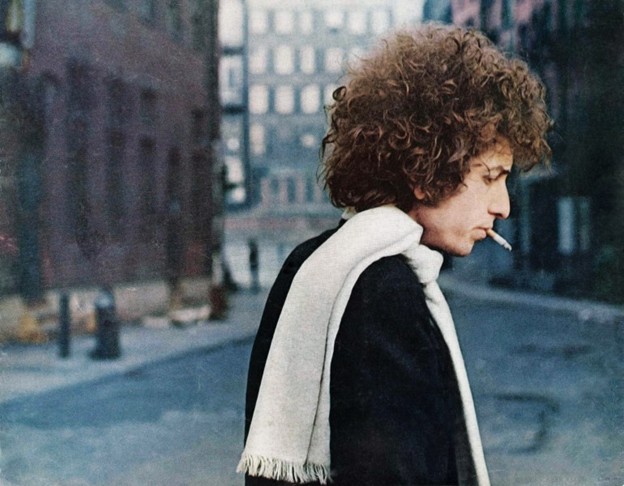
Preface: Bob Dylan and Ralph Gleason
In my book, The Life and Writings of Ralph J. Gleason, I take readers inside the music critic’s evolving view of Bob Dylan from 1963 to 1975.
As 1964 dawned, Ralph Gleason had practiced jazz criticism for nearly 30 years. Although he occasionally covered other music genres with great acuity, Gleason focused mainly on the music of artists such as Ornette Coleman and John Coltrane. Artists associated with a new freedom in jazz allied with Leftist freedom movements around the globe.
Gleason, too, aligned with these causes and wrote about this new juxtaposition of jazz and politics. These writings brought Gleason into conflict with his editors at DownBeat and the San Francisco Chronicle. By the end of 1963, the stress was so great that Gleason considered changing his career. He even felt alienated within his circle of Old Left union organizers.
But the pop revolution of 1964 brought Gleason out of his doldrums. A flow of records and concerts by rock artists such as the Beatles and the Rolling Stones gave Gleason a new outlook. Sensing the broader social context of youth revolution, Gleason became enthralled with the new music and its meanings.
Which is why he fell for the music of Bob Dylan.
From 1964 to 1975, Gleason wrote some of the most astute contemporaneous accounts of the singer-songwriter ever written. The two became friends after Dylan played in San Francisco. Gleason hosted Dylan’s only televised press conference from that time.
In 1966, Gleason wrote a full-page review of Blonde on Blonde that remains a classic of the form. The review captured a great journalist coming to terms with a milestone recording. I plan to look at that review in a future post.
Blonde on Blonde, and Gleason’s review, reflect what essayist Susan Sontag referred to as a “new sensibility” in 1960s American culture. Its adherents discarded the old high-low distinctions in criticism. They might admire, for instance, both a poem by Dylan Thomas and a gatefold album by his namesake.
Let’s let Sontag put it in her own words …
Serious Fun
The new sensibility is defiantly pluralistic. It is dedicated both to an excruciating seriousness and to fun and wit and nostalgia. It is also extremely history-conscious. And the veracity of its enthusiasms (and of the supersession of these enthusiasms) is very high speed and hectic. From the vantage point of this new sensibility, the beauty of a machine or of the solution to a mathematical problem, of a painting by Jasper Johns, of a film by Jean-Luc Godard, and the personalities and music of The Beatles is equally accessible.
Susan Sontag, Against Interpretation, 1965.[1]
This new sensibility underlay the writings of a new generation of music journalists. By examining how these young journalists shaped the landscape of pop music criticism, we can gain a better understanding of the values that continue to shape today’s music journalism. Values such as breaking down barriers between high and low culture, accepting pluralism, and expressing personal perceptions and feelings.
Contemporary reviews of Bob Dylan’s Blonde on Blonde in 1966 played a significant role in cultivating this postmodern sensibility within rock journalism. These critiques blend wit and seriousness, reverence and irreverence, while allowing the writer’s insights and emotions to take center stage.
A Merger of Poetry and Popular Music
In the fall of 1965, Bob Dylan began recording his follow-up to Highway 61 Revisited. That album succeeded commercially and is recognized today as one of the greatest rock albums of all time.

But in 1965, there wasn’t a large circle of attuned rock critics to appreciate the album’s revolutionary music. Newspaper reviews dismissed or ridiculed the record for the most part. Some reviewers expressed a lingering resentment of Dylan’s turn to rock music. Others disliked Dylan’s critique of the older generation. The songwriter’s legitimacy as a lyricist was questioned and flat-out laughed at.
However, there were a few exceptions, including Ralph J. Gleason of the San Francisco Chronicle. Gleason wrote of Highway 61 Revisited:
… It is a powerful voice raised in the worldwide moral disaster area. His lyrics are poetry purely and simply, and represent for the first time in our society a merger of poetry with popular music which can have a deep and lasting effect on our entire society.[2]
And so, when Dylan went into the recording sessions for Highway 61’s follow-up, there were very few serious critics to pay heed.
The sessions began in New York City, with Dylan’s touring band the Hawks. Although they continued recording into 1966, the group only produced one usable track. This prompted Dylan to make a career redefining turn – move the session to Nashville. Bringing in some of the city’s finest session players, Dylan started anew and wrapped up the session in March 1966. Titled Blonde on Blonde, the two-disc album hit the record stores on June 20, 1966.

Burying the Put-Down Song
While Bob Dylan worked on Blonde on Blonde, the state of rock criticism changed. A college student named Paul Williams launched the rock fanzine Crawdaddy! in January 1966. The following June, Richard Goldstein started writing his essential column “Pop Eye” for the Village Voice.
Both of these young literary journalists treated popular music with the seriousness usually reserved for classical music and jazz. Yet, Williams and Goldstein wrote with a free-flowing and irreverent sensibility that matched the new spirit of rock music.
For Goldstein, the timing of Blonde on Blonde’s release was perfect, coming just as he inaugurated his column. He saw the album as a departure from Dylan’s recent recordings:
With Blonde on Blonde, Dylan buries the put-down song, a genre he perfected in “Like a Rolling Stone” and “Positively Fourth Street” … There was an increasing sense of futility in listening to this Dylan because, even when he destroyed with acid skill, the question lingered stubbornly — would too many Newports of the soul become Dylan’s trademark? …
There is a softness of imagery, a mellowing of tone; even the voice is huskier. It is as though someone somewhere has sandpapered Dylan’s sensibilities. But softness does not imply limpness. The message, and the impact, are as sharp as ever.
The most moving song on the LP is “Just Like a Woman.” Like any good poem, it captures essences — almost scents — in a series of images that build until, by its conclusion, there is a sense of intimate knowledge …[3]
Goldstein’s prose was viscerally engaging and insightful. It should be noted that he moved in a circle of young New York intellectuals, including Susan Sontag.
Beyond the Capsule Review
For the next several months, reviews appeared around the country.
Los Angeles Times critic Pete Johnson wrote:
Dylan is a superbly eloquent writer of pop and folk songs with an unmatched ability to compress complex ideas and iconoclastic philosophy into brief poetic lines and startling images.
Coupled with his writing talent is one of the worst voices in the annals of high fidelity, but his records sell well because he has generated a romantic legend on the order of James Dean’s.
He alienated some of his followers by a changeover from a non-amplified guitar and harmonica backing to a larger rock-type combo, but the disenchanted were quickly replaced with younger electron-oriented fans …
His songs are peopled with clowns, royalty, dwarfs, freaks, creatures of his fecund imagination, and, weirdest of all to Dylan, conventional folks accepting the insanity of the world. He draws his imagery from mythology, history, psychiatry, philosophy, folk sources, and literature, easily juxtaposing jarring elements with the pungency of a nightmare.[4]
Johnson was one of the best of a new generation of newspaper pop music critics. His lengthy review gave Blonde on Blonde the attention it deserved. Like other critics of his generation, he recognized that the “capsule reviews” of past times were inadequate to convey a critic’s experience of the new rock music.
A Slight Digression
But some music columnists disliked Blonde on Blonde. For example, the writer of “The Jazz Scene” in the Van Nuys News wrote:
In a slight degression from my normal discussions of jazz, I would like to talk about Bob Dylan, who, along with The Beatles, must be considered as one of the two most important musical forces of the 1960s.
Not a particularly inspired writer of melodies, his great strength lies in his lyrics, which must characterize him as the greatest poet of his generation.[5]
To illustrate, the writer ran through several songs from Dylan’s early period, and then continued:
He followed this with some of his most impressive writing, long, rambling James Joyce-inspired pieces of pure imagery, including “Gates of Eden,” “Desolation Row,” and “It’s All Right Ma.”
It was also at this time that he started experimenting with amplified guitars and drums and virtually created folk rock …
His latest, a two-volume set titled Blonde on Blonde, is quite a disappointment. Neither the writing nor the performances are up to his other … albums.
Many times, his lyrics are lost in the overly loud backing, and his voice doesn’t carry the quality of truth and conviction it normally does.[6]
Although this writer appreciated Dylan’s music in general, they felt let down by Blonde.
Pop Art
But a teen columnist in California was far from disappointed.
That writer was Lou Leary. He wrote a column called “The Music Scene,” which ran on the teen page of the Vallejo Times-Herald. Leary reviewed Blonde on Blonde in a column titled, “Bob Dylan has a Work of Art.” The heading expressed the conviction of young rock writers that their generation’s pop music deserved to be taken seriously.
To lighten the serious tone, the column featured a humorous photo of Leary and another student-journalist. They looked down at the album while gazing into the camera, stroking their chins in mock contemplation.

Leary wrote:
Bob Dylan, about whom Allen Ginsberg states, “He is the most influential poet of his generation,” and music critic Ralph Gleason says, “He is the most successful entertainer of the age,” has finally released his new album Blonde on Blonde …
In the past year, Bob has been slowly drifting away from his role as a social commentator and finger-pointer and is now developing into a romanticist. This new set of songs displays the human emotions powerfully, and it is definitely the product of a talented craftsman in imagery …
The only finger-pointing song in the album is “Memphis Blues Again,” which is probably the best in the set. Dylan’s world of clowns and other assorted fools is again described, and it is reminiscent of his earlier song “Desolation Row” …
Lately, the critics of Bob Dylan have been saying that his new-style songs are morbid and vague. They will be silenced when they hear “I Want You” and the other works of art on this album. These songs are artistic, near perfection, impressions of love, desire, hate and satisfaction … Although Bob is still tremendously dissatisfied with the world (but then who isn’t?), he is now able to withstand it, and now that he has reached this point, he will become an even greater. artist.[7]
Leary focused on the expressivity of Dylan’s singing rather than criticizing his rough-hewn voice as other critics routinely did. His column illustrates the vital role played by newspaper teen columns during a period in which rock music matured and began to be thought of as “adult-oriented.”
The Album that Saved Crawdaddy!
About the same time Leary’s column ran, rock critic Paul Williams published the fourth issue of Crawdaddy! in July 1966.

Now a college dropout, Williams considered ending Crawdaddy! until he heard Dylan’s new album:
I listened to Blonde and Blonde over and over and I loved it so much I felt a keen need to write about it, to tell the world what this record and this artist’s work meant to me …
I decided to publish the fourth issue of Crawdaddy just so I’d have a place to write this article for, and the chance that somebody would read it … I remember hitchhiking to Hanover, New Hampshire … [and] all the way there and back I was thinking about this article, and the things I wanted to say, and the problems of how to say them in a way that would tell the truth about my experience of this wondrous work and wouldn’t just create more misunderstanding …[8]
Williams’ completed review, “Understanding Dylan,” prompted the 18-year-old writer to continue his magazine to give the article a platform. Thus, Blonde on Blonde changed the course of music journalism history – Crawdaddy! became one of the most vital sources of pop music criticism of its time.
Williams’ piece is a fascinating expression of his perceptions and feelings about Blonde on Blonde. It’s also a cautionary tale about seeking absolute meanings in poetic song lyrics. So, let’s look at an excerpt …
You’re Irrelevant
Paul Williams, “Understanding Dylan”:
The way to understand Dylan is to listen to him. Listen carefully. Listen to one song at a time, perhaps playing it over and over to let it sink in. Try to see what he’s saying. A song like “Visions of Johanna” or “Sad Eyed Lady of the Lowlands” or almost any of his more recent songs is full of pictures, moods, images, persons, places and things. “Inside the museums,” he sings, “Infinity goes on trial.” It doesn’t mean anything, but you know what a museum feels like to you … There’s no explanation because the line is what it is, but certainly the line, the image, can turn into something living inside your mind. You simply have to be receptive …
I could explain. I suppose I could say that “Memphis Blues Again” is about displacement and tell you why Dylan would think of a senator as “showing everyone his gun.” But the truth is that wouldn’t give you anything. If you can’t feel it, you can’t get anything out of it. You can sneer and say, “it’s commercialism” or “it’s about drugs and I’m above it,” but not only are you dead wrong, you’re irrelevant.
Arabian Drums
Williams then displayed a deep level of self-reflection for an 18-year-old:
In many ways, understanding Dylan has a lot to do with understanding yourself. For example, I can listen to “Sad Eyed Lady of the Lowlands” and really feel what the song is about, appreciate it; but I have no idea why a “warehouse eyes my Arabian drums” or what precise relevance that has it. It does make me feel something. The attempt to communicate is successful, and somehow the refrain “Now a warehouse eyes my Arabian drums” has a very real relevance to me and my understanding of the song.
So it isn’t fair to ask Dylan what the phrase means, or rather, why it works. The person I really have to ask is the person that works on – me. And I don’t know why it works, ie can’t explain it. This only means that I don’t understand me. I do understand Dylan. That is, I appreciate the song as fully as I believe as possible …
We have established, I hope, that art is not interpreted but experienced … With that in mind, let’s take a cursory look at Blonde on Blonde, an excellent album which everyone with any admiration for the work of Bob Dylan should rush out and buy it at once.
A Cache of emotion
Williams continued:
Two things stand out: the uniform high quality of the songs chosen for this extra-long LP, and the wonderful, wonderful accompaniments … Certainly, Dylan’s songs have never been better presented.
And they are really fine songs. It’s hard to pick a favorite. I think mine is “Memphis Blues Again,” a chain of anecdotes bound together by an evocative chorus. …
Blonde on Blonde is a cache of emotion, a well-handled package of excellent music and better poetry, blended and mashed and ready to become part of your reality. Here is a man who will speak to you, a 1960s bard with electric lyre and color slides. A truthful man with X-ray eyes you can look through if you want. All you have to do is listen.[9]
In writing that “Art is not interpreted but experienced,” Williams manifested the key precept of Sontag’s “new sensibility.” She highlighted this by writing an essay called “Against Interpretation,” which became the title of Sontag’s influential book of essays.
Williams’ “review” was actually an extended discourse on how to assess Bob Dylan’s work fairly. His comments on Blonde on Blonde, as Williams noted, were just a “cursory look.” This foreshadowed the long-form rock criticism to come, with its forays into the context surrounding a record or artist.
A Breakthrough
Williams later wrote:
My Blonde on Blonde review was a breakthrough for me as a writer, creatively and professionally. It was soon reprinted in Hit Parader magazine and then used as the introduction to a songbook published by Dylan’s publisher. I began to feel like a real writer. I’d hoped from the beginning that record reviews could be a way for young writers to express themselves, a vehicle for listeners to articulate and share their visions of this new world we were finding ourselves in. For the first time, I really felt satisfied with something I’d written for the magazine. That, and the great new music that seemed to come out of nowhere continuously at that time, was a good incentive to keep publishing.[10]
Could there be a purer expression of a music journalist’s leap forward following a peak musical experience?
Conclusion
Two weeks after Williams published his review, Bob Dylan crashed his Triumph motorcycle near Woodstock, New York. He sustained serious injuries and withdrew from the public eye. This significantly changed the course of his career and sidelined one of pop music’s most creative artists for months.
A year and a half later, in late 1967, Dylan was back in form on his next album, John Wesley Harding. And today, thirty-two studio albums later, Dylan remains a creative presence in contemporary rock music.
Dylan’s recorded output has enthralled and maddened several generations of music critics since Blonde on Blonde was released. The album continues to stand out among critics and fans, reaching the number two position on Rolling Stone’s 2012 readers’ poll of best Bob Dylan albums. Writers continue to publish reviews.
However, the contemporaneous reviews of Blonde on Blonde in 1966 hold a special place of honor. Those texts by a new generation of pop music critics played a significant role in cultivating a postmodern sensibility within rock journalism.
By exploring how these young journalists influenced the world of pop music criticism, we can gain a deeper understanding of the values that still guide contemporary music journalism. These values include dismantling the distinctions between high and low culture, embracing pluralism, and conveying personal experiences and emotions.
Further, Paul Williams’ account of writing his Blonde on Blonde review shows that writing about music requires breaking down barriers within ourselves, experiencing the music fully without chasing illusory fixed meanings.
As Susan Sontag expressed so beautifully:
Transparence is the highest, most liberating value in art – and in criticism – today. Transparence means experiencing the luminousness of the thing itself, of things being what they are …[11]
Thus, for a critic commenting on a particular creative work,
The function of criticism should be to show how it is and what it is … rather than to show what it means.[12]
Paul Williams, Pete Johnson, Lou Leary, and Richard Goldstein accomplished this with their reviews of Dylan’s masterwork, Blonde on Blonde.
Notes
[1] Susan Sontag. Against Interpretation (Farrar, Straus & Giroux, 1967): 304.
[2] Ralph J. Gleason. “Dylan Places Poetry in the Hands of Youth,” San Francisco Examiner This World, Sept. 19, 1965: 21.
[3] Richard Goldstein. “Bob Dylan: Blonde on Blonde,” Village Voice, June 1966. Webpage retrieved Aug. 15, 2025: https://www.rocksbackpages.com/Library/Article/bob-dylan-iblonde-on-blondei-columbia-2
[4] Pete Johnson, “Playboy Hops on Dylan Bandwagon,” Los Angeles Times, July 3, 1966. Webpage retrieved Aug. 15, 2025: https://www.rocksbackpages.com/Library/Article/bob-dylan-iblonde-on-blondei-columbia-c2l-41-028-841.
[5] Mike Davenport. “The Jazz Scene,” Van Nuy News, July 29, 1966: 47.
[6] Mike Davenport. “The Jazz Scene,” Van Nuy News, July 29, 1966: 47.
[7] Lou Leary. “Bob Dylan has a Work of Art,” Vallejo Times-Herald, July 9, 1966: 30.
[8] Paul Williams, editor. The Crawdaddy! Book (Hal Leonard Corporation, 2002): 28.
[9] Paul Williams. “Understanding Dylan.” In Paul Williams, editor. The Crawdaddy! Book (Hal Leonard Corporation, 2002): 34-36.
[10] Paul Williams, editor. The Crawdaddy! Book (Hal Leonard Corporation, 2002): 29.
[11] Susan Sontag. Against Interpretation (Farrar, Straus & Giroux, 1967): 13.
[12] Susan Sontag. Against Interpretation (Farrar, Straus & Giroux, 1967): 14.
Leave a Reply