Introduction
For jazz fans, the phrase “Central Avenue” conjures up visions of modern jazz musicians like Dexter Gordon inventing bebop in the late 1940s. But the thoroughfare buzzed decades before that with the support of L.A.’s leading Black newspaper.
Running through the historically Black section of Los Angeles, the Central Avenue district became a vibrant site of the community’s businesses, institutions, and neighborhoods. Starting in the 1920s, it featured a lively jazz scene that attracted Black musicians visiting the West Coast, as well as local talent. The street became a source of brightness during the darkest years of the Jim Crow era.
Located in the district was a leading African American newspaper, the California Eagle. Founded in 1879, the paper had grown into the state’s most prominent African American publication by 1925. The Eagle’s publisher, editors, and writers also worked for civil rights causes, especially the fight against new inequities brought on by the Great Depression.

Many of those inequities impacted Black musicians in L.A. and around the country. At stake was not only their jobs, but their dignity and identities. Writers at the California Eagle understood these stakes well because they, too, experienced them. And from the late 1910s to the 1930s, the Eagle’s journalists covered the emergent Central Avenue scene with uncommonly deep personal interest.
These journalists not only covered the Central Avenue cultural scene but also helped nurture it. Their writings are essential because they show how music journalism fosters progressive social change and resists the overwhelming forces of social regression.
And so, let’s take a look at the California Eagle’s role in cultivating Black music in Los Angeles in the decades before World War II.
In the Music World
Like many American newspapers in the 1910s, the California Eagle featured a column devoted to music. But that feature, “In the Music World,” was vastly different from those in white newspapers.
How could it not be? The opportunities and freedoms afforded to African American composers and performers were significantly limited compared to those available to their white peers. Two hundred fifty years of enslavement and decades of segregation had blocked them from conventional means of musical education and training, while distancing these musicians from their African musical heritage.
And in 1919, music was in the air like never before. The new 78 rpm records played on commercial radio stations brought the sounds of the latest bands and singers into living rooms across the country. However, these artists were predominantly white, as both record labels and radio stations hesitated to take chances on Black musicians.
However, white dance bands popularized a form of music created by African American musicians and rooted in Black experience: jazz. The new syncopated rhythms triggered a global mania. And created opportunities for Black musicians, wrote the Eagle’s John A. Gray in his column, “In the Music World”:
Never before in the history of the world has music been given the recognition that is being given to it today. Music is no longer a luxury; it is indeed a necessity.
The colored musician is being given a chance. Will he make good? Read your daily papers and your monthly magazines for further information on this subject. See what support is being given to him by the other race, and then ask yourself what support you are giving him.[1]
Gray recognized that if Black musicians were to succeed, they required support from their community.
Allies
However, Gray also understood the importance of white allies in making his case. Since the 1800s, a handful of white musicians and scholars had written of the virtues of African American spirituals and folk songs. Gray used their words to underscore his arguments.
For example, in one column, he quoted Natalie Curtis Burlin, an influential American ethnomusicologist. Burlin had been transcribing Black songs for a decade and was in the process of publishing a series of volumes called Negro Folk-Songs.
Gray quoted Burlin’s call to the music industry to look at Black sacred music:
We have enthusiastically adopted the less serious side of the black man’s music, the ragtime and the plantation melodies. It is time that we were making a real use of his highest form of self-expression, that unique type of song known as the “spiritual.”[2]
A couple of months later, Gray turned to another Black musical form, one stolen and capitalized on by lower-melanated musicians.
The Rhythmic Pulse of Humanity
Gray wrote:
The popularity of jazz is due to its appeal to the primitive in man. Itself is primitive since it consists principally of strong rhythms, and rhythm is the foundation of music … The keynote of the universe is rhythm. One writer has said that rhythm is the “motion with which the universe is alive. It is the first expression of Creative Mind. This being the case, then, the cause for the popularity of jazz is readily explained.[3]
Gray devoted an entire column to jazz in October 1919. At that point, no record labels had recorded Black jazz musicians. But, Gray argued, those musicians were essential to the development of American music:
[Jazz] is not national nor racially alone in its appeal, as this is proven by its instant adaptation in many foreign countries. Hence, the rhythmic pulse of jazz is in accordance with the rhythmic pulse of humanity. It can be observed also that in many cases, melody plays a very little part. Indeed, there are times when there is none.
This brings us to ask the question: What will be the future effect of jazz on the development of music? Who can answer this question fairly?
At least we can say that jazz sans noise and sans harshness, or in other words, stripped of its crudeness, will leave us that basic principle of music, RHYTHM. we can safely say then, that future music will be affected from a rhythmical standpoint. One great composer, the late Leon Cavello, has predicted that ragtime would have an important part to play in the development of American music.
Now, ragtime and its child, jazz, are both creations of the brain of the negro, as nearly everyone knows. Shall not the creators of these basic fundamentals be also the developers of them? Who can say yea or nay?[4]
Gray’s article began the Eagle’s long advocacy for Black jazz musicians. With its office in the Central Avenue district, the newspaper was situated at the epicenter of a rising jazz scene that would shape music history.
Jazz Appreciation
Eagle writers continued to cite outside experts on the virtues of Black music. An associated theme, also found in the music writings of other Black papers, was that jazz possessed the potential to evolve into a higher art form akin to classical music.
That argument can be seen in an Eagle article entitled “Will Jazz Remain With Us Always?” from early 1921. The piece included lengthy quotes by Black composer and singer John Rosamond Johnson, who wrote the famous hymn, “Lift Every Voice and Sing.”
The uncredited writer of this article, likely Gray, used Johnson’s words to present a lighthearted history of Black music:
Jazz is the evolution of plantation music. But first, the Negro, when brought to America as a slave, had no idea nor ambition to sing. He was a happy, contented character, but he knew only of God and the devil with a big ‘D.’ So he sang of these, and thus we have what is known as the spirituals.
Then love came into his soul. He sang of Dianah and his Mandy, and we have what was known as ‘coon songs’ in days passed. Later, as a freeman, he earned money. He spent much of it on clothes and became the dandy and the dude. Coon songs became ragtime, which later became syncopation.
Then rest took hold of the Negro and the syncopation, with its even rhythm, became the jazz, which is nothing more or less than several rhythms played as one. Instead of one melody, readily distinguishable, jazz, when properly played, is several different rhythms played by several groups of instruments at the same time. It is founded on the same principle on which are based on our symphonies and big overtures.
In fact, I know of many cases where jazz has aided in the appreciation of the works of our great music masters, for the ear trained to follow the several rhythms of jazz has appreciated fully the numerous strains, blended into one musical whole, which have made the great symphonies the works of art they are.[5]
An audacious claim for its time: listening to jazz enhances one’s appreciation for classical music.
The Central Avenue Jazz Scene
As the 1920s progressed, the Central Avenue scene began to take shape, with places emerging for creating and enjoying music.
One of these was the Spikes Brothers Music Store, which opened in 1919. The shop sold instruments and ran a music label. It also sold recordings by Black artists, one of the few places in Los Angeles to do so.
Another headquarters for musicians was the Black Musicians’ Union, Local 767. It helped artists find jobs and brought local musicians together with visiting musicians in their rehearsal rooms.
Before the more well-known clubs opened on Central Avenue, the district’s hot spot for dances and concerts was the Elk’s Hall. It boasted a ballroom with a capacity of 2,000 that hosted shows and jam sessions.
However, there were forces arrayed against the community. At the end of 1925, the Eagle complained about a double standard for policing in white and Black neighborhoods. At issue was a new crackdown in a neighborhood that ran along Central Avenue:
The chief trouble has been the custom of the [police] to make spectacular raids in the Newton Street District, in which they were wont to sweep through the district with high power men and herd up petty lawmakers … [while] at the same time having their own [white] districts where everything men and women are big enough to do going on without restraint. They have actually … allowed vice to go on unhampered in the [white] sections where the purity squads should gather their harvest.[6]
The crackdown occurred as resentment over segregation rose after LA proposed a zoning law to segregate the city’s blacks, ordering some out of their houses. In an Eagle article titled, “Do You Want to Live on the River Bottom?” the writer said:
We can’t go into a white restaurant in this city and have a meal. We can’t go into a theater and buy a decent seat. We can’t go into a dance hall, a skating rink, or a bathhouse.[7]
The writer said, “Organization is our only salvation.”[8]
Hysterical Beings Under the Influence of Jazz
As the Central Avenue music scene emerged within this oppressive racial climate, the Eagle supported key venues, concerts, and musicians on its arts page:

On that page, Gray continued to tout the potential of jazz in his column. As the Jazz Age sparked debates about the aesthetic and moral values of jazz, Gray continued to seek out musical authorities who legitimized the genre.
For example, in one piece, Gray quoted Italian composer Alfredo Casella, who said that jazz should be developed as an American art form. After listening to a jazz concert, Casella said that “it gave me extraordinary pleasure, such more indeed than many symphonies I heard.”[9]
In another column, Gray expanded the theory of jazz rhythm he introduced in an earlier column. He also defended the music against its growing detractors. He noted the jazz mania sweeping Europe and parts of Asia. He asked, “Why are the most sedate and refined people turned into panting, perspiring, and hysterical beings when under the influence of jazz?”[10]
Gray again made his case for “primitive” rhythmicity and expanded it into a theory of civilization:
Music can be neither moral nor immoral. Music is nature itself. Whatever immorality is imputed to jazz or any other kind of music is a result of association, never the result of any inherent quality in the music itself. Historians agree largely that the more primitive peoples of the earth are, for the most part, more moral than the more enlightened ones. It seems that the closer we live to nature, the healthier, more moral and natural we become; while the more civilized the races, the more immoral, unhealthy and unnatural we’ve become.[11]
And, what could be more unnatural than the industrialized enslavement of human beings?
Tapping the Words of Scholars
Another “unnatural” condition was racial segregation. But being denied access to white facilities only encouraged the city’s Black district to create its own.
One was the Helen Hunt Jackson Library on Central Avenue. With the Eagle‘s help, the Library helped disseminate knowledge about Black music. For example, a news brief in the Eagle urged readers to visit the library and read an article by V. F. Calverton in Current History, a journal founded in 1914 by the New York Times.
In the article, Calverton praised the contributions of African Americans to the country’s vernacular culture, citing spirituals, blues, jazz, and folklore as examples. Calverton was a radical left writer who edited An Anthology of American Negro Literature in 1929. The Eagle piece shows how liberal publications were an essential source of ammo for journalists making the case for Black music.
The Library also published a column in the Eagle called “Library Book Notes,” which highlighted books at the library that featured the contributions of African American music. One example is Paul Rosenfeld’s book, An Hour with American Music.
Indeed, as the 1920s drew to a close, a circle of influential scholars and field researchers contended that the heart of American music lay in its indigenous idioms, such as spirituals, folk music, and early jazz. Genres primarily developed by working-class musicians.
In October 1929, however, a crash in the nation’s stock market disproportionately devastated this class as the Great Depression threw many into poverty. African Americans were especially walloped. Even some soup kitchens turned away Blacks.
Central Avenue Venues
Yet, as a testimony to the hard-won resilience of African Americans, black music scenes, such as Central Avenue, continued to thrive. In the late 1920s and early 1930s, new Black-owned venues emerged on Central Avenue, presenting jazz shows.
For instance, the Dunbar Hotel, a refuge for traveling black entertainers staying in L.A., had a bar that featured live music. Adjacent to the Dunbar was the Apex, the top night spot on Central Avenue. These clubs joined Elk’s Hall in hosting top jazz musicians.
In addition to these venues, a variety of other Black-owned businesses in the district helped keep the nightlife thriving. Restaurants, movie theaters, and other entertainment destinations gave patrons a welcoming alternative to segregated Los Angeles venues. The Eagle nurtured these local businesses with articles and nicely illustrated advertisements.
As the district acquired more nightspots, the Eagle’s music coverage expanded. In 1926, columnist Charles L. Upton scouted a young journalist who would be part of that enlarged coverage:
This writer has discovered some exceptional talent in a waiter by the name of Harry Levette, who is one of the recent arrivals from the East. Mr. Levette, who hails from Kansas City, is a writer of poems and verse and wrote several articles for the Kansas City Call.[12]
Upton shared a poem in unrhymed verse by Levette called “The Bomber.” Without saying so, it was clearly inspired by the spate of bombings targeting African Americans in the 1920s by the Ku Klux Klan and other white supremacist groups. The most egregious was the 1921 Tulsa Race Massacre, where airplanes dropped fire bombs in a Black district. In his poem about one of these bombers, Levette concluded:
The filthy ghouls who rob unguarded graves
Never had souls like this! …[13]
The Eagle hired the poet-writing waiter and six months later promoted him to Sports Editor. However, Levette was also interested in entertainment writing, and by early 1928, he penned a column called “Behind the Scenes with Harry.” In it, he reported on and recommended movies, vaudeville acts, and musical performances.

Marvelous Cornet Notes
Levette was one of the first Eagle writers to cover the emergence of orchestral jazz in L.A. The idiom originated in Black dance bands in the East and Midwest, led by bandleaders such as Earl Hines, Fletcher Henderson, and Duke Ellington.
In a 1930 column, Levette wrote about an upcoming concert by Ellington at the Shrine Auditorium. And, as Everette noted, another Black jazz dignitary was in town:
Louis Armstrong, stopping the radio world every night with those marvelous cornet notes at Sebastian’s Cotton Club, signed a renewal of his contract for another six weeks … White musicians from all over the city come to watch and study Louie’s throat and breath control as he plays, wondering how he does it.[14]
Sebastian’s Cotton Club was a white club that barred Black patrons. However, for Everette, it was a point of pride that Black musicians drew big crowds in these venues, and that white musicians studied their technique. Armstrong had just moved to L.A. with an orchestra that included fireball musician Lionel Hampton on drums.
However, things took a turn for the worse for Armstrong in the spring of 1931.
Busted
“‘King of Trumpet’ Gets 30 Days in Jail,” read the front page headline of the California Eagle. The uncredited writer, probably Levette, announced the news:
Louis Armstrong, reputed to be the world’s best cornet player, was sentenced to serve 30 days in the county jail … Armstrong was convicted of the charge of having a quantity of marijuana in his possession.
The drug is one that has come into widespread usage in the city within the past few months. Users of the drug smoke it in cigarette form.
Known as the “King of the Trumpet,” Armstrong has been employed at the Cotton Club in Culver City for the past few months. His bizarre method of playing the trumpet and his individualistic interpretation of popular songs have won him a wide following among nightclub followers and radio fans …
Armstrong is married and has been living at the Dunbar Hotel with his wife.[15]
Armstrong was paroled two weeks later, according to the Eagle, and returned to Chicago. But the happy ending wasn’t enough to light up Central Avenue; its energy dimmed as the Depression grinded on.
Club Alabam on Central Avenue
However, hope came at the end of the summer of 1931. A new nightclub was coming that would put Central Avenue jazz on the map. The Eagle played a crucial role in building excitement.
It all started when local Black bandleader Curtis Mosby took out a lease on the building that once housed the Apex nightclub, which had closed. He announced plans to open a new venue, named Club Alabam.
The Eagle broke the news in a bold headline on its entertainment page:

After the club opened, Levette wrote that it brought life back to the district:
The dizzy white lights are dancing daringly again, lightsome, lilting, laughter is tinkling from lips curved merrily in happy faces of white, brown, cream, or rich orange as the gay, many-colored gowns of women of all races flutter like so many tropical butterflies.[16]
Stories about Club Alabam became regular occurrences in the Eagle’s entertainment page.
That page also included insightful articles on jazz by uncredited writers. For example, a piece on local Black bandleader Leon Herriford addressed the aesthetics of smooth tones in jazz:
All too frequently, criticism comes from white music critics that some of our colored bands spoil the effect they could make and the quality of their execution by playing jazz numbers too loudly. In most cases, this is very true. So Leon Herriford, widely known orchestra leader, must have [rooted out] these faults … for the brand of music rendered by them is absolutely devoid of the harsh, noisy, discordant traits that shock the lover of harmony.
Smooth, mellow, harmonious, every artist from the leader on down, putting his individuality and his very soul into his instrument, their music is a joy to the most discriminating ear. If it is jazz, it is stirring, thrilling, happiness-filled, reacting on the senses like a tonic. If it is ballads, soothing, romantic is the effect, with the melody lingering in the memory hours after, like rare old wine or the haunting fragrance of an old-fashioned garden.[17]
The writer was likely John A. Gray, who had been covering jazz in the Eagle for 12 years. As 1932 dawned, Gray launched a new column.
The Musical West
Gray titled his new column, “The Musical West.” In it, he continued his astute defense of “Negro music.”
This can be seen in one of the first columns, in which Gray cautioned against the appropriation of jazz by white bandleaders:
The [music] writers are giving Paul Whiteman and other[white] men the credit for having created jazz. To us, the idea is ridiculous, but if we are not careful, the future generations will read of the origin of jazz and will find no mention of the Negro as its creator.
It is true that these primitive rhythms are powerful, so powerful that our composers are content to let them remain in their primitive state. Foreign composers are utilizing them in serious compositions. The recent piano concerts by Tansman, a Polish composer living in Paris … depends largely upon its effectiveness through the use of jazz rhythms.[18]
Gray referenced Alexandre Tansman, a Polish orchestral composer who integrated jazz influences into some of his works in the 1930s. Gray called on young Black jazz musicians to exercise the type of discipline practiced by symphonic musicians:
We have many talented persons, but the majority are not willing to develop their talents. What would be the results if boys with talent like Louis Armstrong and others were given a severe [thorough] schooling and music education? That is what happens in Europe. That is why they have produced so many masters …
We as Negros must learn that any sign of exceptional talent among our youths is also a sign for plenty of hard work. We must encourage these young people and their efforts, but we must also be careful not to pamper them or to overrate them, because we shall then be defeating the very purpose for which we are working. Negro rhythms are powerful and irresistible, but like our desert sands, they must be watered and cultivated if we ever wish to see them flower into their fullest beauty.[19]
A remarkable call to action.
Wizards of Melody
As Gray urged Black jazz musicians to reach their full potential, the Eagle upped its splashy coverage of swing bandleaders like Duke Ellington, Louis Armstrong, and Cab Calloway. The newspaper published lengthy articles with striking illustrations and bold headlines.
“Duke Ellington’s Band Takes Town by Storm,” declared one page-topping headline in August 1932. The jubilant piece painted a vivid picture of Duke Ellington’s stint at the Orpheum, a major white theater in L.A. Although the venue was segregated with separate seating for Black patrons, the article shows tremendous pride in a Black orchestra leader attracting huge crowds. Ellington and other black bandleaders were inventing swing jazz at that time, years before Benny Goodman and others popularized it.
The article described the excitement:
With capacity crowds nightly thronging into the magnificent Orpheum Theater, Duke Ellington’s wonder band has been the center of the city’s attraction since they were welcomed in here last Thursday, with a reception unequaled by any even extended here to members of royalty.
Black turnout was exceptional:
So well attended have been their four-a-day performances by colored patrons, that a glance around the house created the impression that nearly half the audience was of the same race as those wizards of melody who are greeted with a storm of applause at the rise of the curtain.
… Following in quick succession, “Stardust,” original compositions by Ellington, “The Tiger Rag,” and other requested favorites, the whole choice morsel of joyous syncopation seems ended all too soon.[20]

The writer pointed out a rising star in the show:
In between the orchestra numbers are three of the finest and most original acts ever presented by vaudeville artists, white or black. Star of these is little Ivy Anderson, a local girl who since she was discovered by Ellington here a year ago, has become the toast of the nation and the queen of the footlights … Singing the number “Rhythm,” as she has been doing the first week, her round full tones with every word distinctly molded, she has swept the crowds off their feet and been called for an encore after encore. [21]
Not surprising; Anderson was one of the finest jazz vocalists of all time.
Stop! Look!
During the 1930s, well-known Black jazz musicians playing in L.A. began booking engagements at Central Avenue venues. The Eagle stood ready to break the news.
For instance, an article announced that Louis Armstrong and his orchestra, directed by Les Hite, would play at the Elk’s Hall. The writer expressed pride in the upcoming show:
This district is proud of the fact that this occasion will be Louis Armstrong’s first and only ballroom appearance on the coast. And the palatial Elks Ballroom will no doubt be filled to the last space.[22]
Armstrong’s performance was in connection with an engagement at the New Cotton Club, a white venue. Cotton Club regulars appeared at the Elk’s Hall with Armstrong, including Lionel Hampton, the “world’s greatest eccentric trap drummer.”[23]
The Eagle ran striking illustrations and advertisements for Armstrong’s L.A. shows:

Dark Angel of the Violin
However, less-known but widely respected Black jazz musicians also garnered attention in the Eagle.
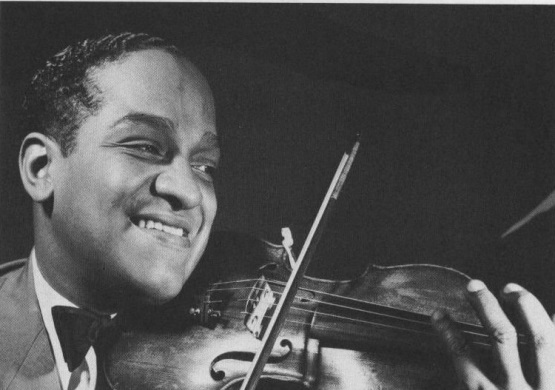
One of these was rising jazz violinist Eddie South. Classically trained in Europe, South was denied positions in orchestras because of his race. Thus, he created his own band and toured the West Coast, including a concert at the Elks Ballroom. An Eagle writer said:
Eddie South, “Dark Angel of the Violin,” and his International Orchestra are expected to attract the greatest crowd of dance and concert lovers to the Elks Auditorium that has ever packed the hall … South has been repeatedly acclaimed the greatest of modern violinists … The European tour of the orchestra was a triumphal procession, with crowds greeting and applauding them …[24]
The article appeared on the front page, accompanied by an impressive illustration of South – a declaration of respect for a Black jazz virtuoso welcomed in European concert halls as well as Central Avenue nightclubs.

Too Far-Fetched for the Natives
Harry Levette continued to report on jazz performances in the district and around Southern California. And John A. Gray continued his music advocacy as the founding president of the Los Angeles Musicians Association. He ended his column, “The Musical West,” in 1932 after a two-year run. That ended his 15 years at the Eagle; he no longer wrote for the paper, devoting himself to the Association and teaching music.
The Eagle thus lacked an advocate for Black music, jazz specifically. One columnist, J. Cullen Fentress, even criticized the capacity of local jazz fans to appreciate the music:
The recent sojourn of Duke Ellington’s aggregation of musicians here on the coast, and its failure to click as expected, gives rise to a question. What type of music will the local yokels come out in droves to hear?
Duke Ellington’s music has become generally recognized as original and a distinct departure in the interpretation of jazz, one of the only real things that has come out of America. Yet, on his recent trip to the coast, he didn’t draw as well as expected. Why?
… Dukes’ sophisticated and ultra-modern rhythms are a little far-fetched for the natives to grasp. His style and his compositions have been classed with those of Beethoven and others of like accomplishments.
A parallel to the Ellington situation and local orchestra circles was the music of Eddie South. His style didn’t seem to click with the natives, yet he has been put in the same bracket with the famous violinist Rubinoff and others, which he richly deserves.[25]
Central Avenue: End of an Age
The world of jazz, and its microcosm on Central Avenue, were in transition in the early 1930s. There were fewer concerts by big-name artists, and the jazz scene lost its energy. Articles in the Eagle described a district in decline, one writer saying that Central Avenue was the “street of a thousand romances and still more broken dreams.”[26]
The Jazz Age was fading, along with the public’s taste for traditional jazz. Swing jazz had yet to reach the mainstream, except for a handful of enlightened fans such as writer John Hammond. However, Black communities such as those on Central Avenue were well-versed in the sounds of swing, as presented by gifted musicians like Duke Ellington.
But, according to Fentress, Central Avenue jazz fans were looking for a more accessible type of jazz:
The one colored orchestra, and one of the best that will be accepted in a wholehearted fashion from the East, is that of Cab Calloway, His Highness of Hi-de-Ho, and that because of his down-to-earth style and his knack for clowning.[27]
Fentress soon had a chance to test his theory.
Calloway
When Cab Calloway made his first trip to the West Coast in the fall of 1935, the Eagle spread its wings to embrace the iconic musician.
The vocalist-bandleader rose to fame at Harlem’s Cotton Club in the early 1930s. He acquired a nickname, “The Hi De Ho Man,” from the chorus of his 1931 hit song, “Minnie the Moocher. Like Ellington and Armstrong, Calloway performed in a series of short films made in Hollywood, which brought him to the West Coast in October 1935.
When it was announced that Calloway would perform at L.A.’s famed Paramount Theater, the Eagle cranked up the excitement for days ahead, running striking photos of Calloway captioned with announcements of the upcoming event:


After Calloway arrived, the newspaper devoted most of a page to Calloway-related content. The lead article proclaimed:
Cab Calloway came to town last Tuesday morning, and Los Angeles, from its humblest Negro citizen to its highest city officials, welcomed him with honors befitting a king.
And he, in reality, the king of hi-de-ho, enjoyed it all, accepting the plaudits and admiration from all that revealed a graciousness and culture equal to his great musical talents … Hundreds crowded around the Union Station and everywhere his party went after leaving the train in a long parade headed by police motorcycle escort.
The first stop was at the La Vada Apartments, their domicile during the residence here …[28]
The La Vada Apartments held the distinction of being the first modern apartment buildings in Los Angeles that were built and owned by Black Angelenos.
The Eagle writer then described Calloway’s visit to an L.A. city council meeting:
… all business stopped, and the chairman asked that Mister Calloway sing for them. He demurred at first because of having no piano but accepted with a provision that the rest of his party second him in the “hi-de-ho” of his famous “Minnie the Moocher.”
It was the most unusual occurrence that has ever happened in the council chambers of Los Angeles.[29]
Swing Time!
Calloway’s successful stint in L.A. coincided with a new music craze sweeping America: swing jazz. The triggering event happened the previous summer, just a few miles from the Central Avenue district.
On August 21, 1935, white bandleader Benny Goodman and his orchestra began a stint at L.A.’s Palomar Ballroom. Playing hot arrangements by Black composer Fletcher Henderson, the Goodman band exhilarated audiences. As the excitement spread, the Swing Era took off.
The only response to this milestone in the Eagle at the time was by a jazz-loving sports columnist. Without mentioning Palomar specifically, he lauded Goodman’s music and noted the clarinetist used a Black arranger, Henderson.
Indeed, over the following months, Goodman continued to integrate his band. Unsurprisingly, the Black press took note of these additions. For instance, an Eagle article from the Negro Press Bureau said:
Ofay [white] bandleaders are beginning to despair of waiting for a Negro musician of sufficient pale skin to “pass” as a Spaniard or something other than a Senegambian, in order to bolster up the music of their orchestras. Judging from the recent decision of Benny Goodman, the acknowledged peer of American “swing” bands in taking on Teddy Wilson, stellar New York jazz pianist, the above suspicion rings quite true.[30]
Swing With Me
This article demonstrated how the Eagle came to rely on African American wire services for jazz commentary from a Black perspective. However, in the summer of 1936, the newspaper introduced a new music column written by one of its own staff members.
“With the Orchs,” penned by Freddy Doyle, delivered timely information about jazz orchestras playing in Los Angeles. In his first column, Doyle set the tone:
Hi Gang, everything is mellow and mild, so latch on and swing with me.[31]
Doyle wrote about how Lionel Hampton invited him to a jam session at the Paradise Café, a local white nightclub. It featured Hampton and “outstanding musicians of other ofay bands.”[32] Doyle expressed his admiration of Hampton’s technique and then expressed solidarity with a musician and a record producer, both white:
Gene Krupa, the world’s greatest “ofay” drummer with Benny Goodman, is a fine “cat” and is well liked by all musicians of color … [He is] a staunch admirer of Lionel as well as a good friend, and can be seen most every night watching Lionel “swing.” As you know, Gene is the “cat” who does the swinging with Teddy Wilson and Benny Goodman with Goodman’s trio.
Another great friend and admirer of Lionel is John Hammond, who is the editor of Down Beat magazine. He is a great sponsor of swing music.[33]
It was during Hampton’s stint at the Paradise Café that Hammond first heard him. He later brought Benny Goodman to the club to listen to Hampton, and the bandleader hired him. For four years, they made jazz history together. Doyle’s column described a historic moment in the making.
The Greatest Swing Band in the Country
Doyle’s “With the Orchs” resembled other swing music columns springing up in mainstream newspapers at the time. But it had one significant difference – it presented the point of view of a young Black writer.
And from Doyle’s perspective, the jazz canon created by white historians overlooked Black musicians. For example, he wrote:
According to ofay newspapers and various musicians’ magazines, Benny Goodman’s is rated as the greatest swing band in the country. Well, my dear readers, tune in on Fletcher Henderson some Saturday or Sunday night from 9 to 9:30 on KFI and hear Fletcher play the same arrangements he writes for Goodman and hear for yourself the greatest swing band in the country.
For the past few weeks, Fletcher Henderson’s band has been heard here in Los Angeles because the radio stations have finally decided to release from the East, bands of color. Maybe officials of those stations have decided that they would also like to hear some good jazz music these nights.[34]
Black orchestras struggled to get on America’s airwaves in the 1930s. And often, when their music was played, radio stations programmed it for late at night because they couldn’t secure commercial sponsors for prime time slots.
Doyle continued writing his column until the summer of 1937. He devoted most of his final column to an overview of L.A.’s all-Black musicians’ union, Local 767. The chapter not only advocated for fair wages for musicians, but it also provided a place where young musicians could mingle with pros like Duke Ellington who used its rehearsal rooms.
Miss Thing
When Doyle’s column ended, a gap opened in the Eagle’s jazz coverage. But starting in the summer of 1939, that gap was filled courtesy of the Associated Negro Press.
The ANP ran a review column called “Rating the Records” by Frank Marshall Davis. The Eagle ran the column for a year. Although the feature lacked coverage of the Central Avenue scene, Davis provided nuanced and knowledgeable reviews of classic swing-era recordings. Here’s a sample:
Count Basie has come up with a performance that ranks as phenomenal. The number, “Miss Thing,” covers two sides: according to Vocalion, [it] was waxed unknown to Basie after his band finished a recording session and was playing for a small studio audience. This is pure, unadulterated swing in the completely relaxed, richly colored style of this great band at its best. There are many thrilling moments, but the best is on the second side, with the rhythm section glorifying a muted trumpet that never rises above a whisper.[35]
As Davis’s column neared the end of its run, another Eagle writer launched a jazz column. It offered a remarkably strong defense of Black jazz.
Notes on a Scratch Pad
The writer was Bill Smallwood, who gave his new column an unassuming title – “Notes on a Scratch Pad.” Yet, he displayed a sweeping understanding of Black jazz history.
In his first column, Smallwood commented on how the public ignored Black jazz musicians until they joined famous white orchestras:
It’s funny how interest jumps 100% overnight in a sepia [Black person] once he lands a brow-raising job with the Other Expressions [likely a reference to white bands]. Fletcher Henderson, as an example, is the greatest hot arranger today, but our interest in him was a mere yawn until Goodman put the tap on his shoulder …[36]
Smallwood then presented a lengthy overview of Henderson’s pre-Goodman career. One passage shows Smallwood’s skill as a jazz writer:
Fletcher is best as an orchestra pianist. His solos are always logical and superbly played. He can play the blues in a slow tempo and jump to a touch that is as lusty as the kick of a mule.[37]
In an article adjacent to this column, Smallwood presented a glimpse of New Orleans jazz history, focusing on the role of riverboats in carrying the music northward as part of the Great Migration. In it, he distinguished swing from jazz, defined as New Orleans traditional jazz. He foresaw the coming jazz revival, marked by heated debates over the validity of swing. Also, the column was an early attempt by an African American writer to present jazz history from a Black perspective.
Reassessing the Original Dixieland Jazz Band
Several weeks later, Smallwood wrote an incredible analysis of the jazz literature:
In an effort to evaluate the respective contributions made to music by black and white musicians, I have read and reread all the literature that is available on the subject. There is an amazing divergence of opinion which seems largely based on the social conditions existing at the time. Both in and out of the musical life, there was, and still is to a less extent, a prejudice against us as a people. Until recently, there was a tendency to ignore the major work that we have contributed to swing.
Inferior whites were acclaimed as greater than our musicians, who were accused of crudity. Today the pendulum has swung to the complete opposite of this view, and swing is considered as a wholly Negroid form of art. Either of these views is manifestly absurd. Each has contributed his quota and if the sum total of the white influence is less than that of the black we must remember that this is due to the fact that a white musician has so much to unlearn before he can get to the root of his subject.[38]
This was a fascinating comment. One wishes that Smallwood had elaborated. Instead, he moved on to an example of reverse racism in jazz discourse:
As an example of the current extreme of critical opinion, I find that almost every (non-playing) authority on the subject belittles the magnificent pioneer work of the Original Dixieland Jazz Band. It has been suggested that the fame of the band rests entirely on the fact that it was a white band that succeeded only because the superior colored bands of the period were ignored for reasons of race prejudice.
There is absolutely nothing that I can find to support this contention, which seems to be maintained only by those students who were not actually on the spot or who were not even in their cradles (as I was not) at the time when the Dixieland Band entered into its heyday.[39]
The Seedlings of Swing
Smallwood acknowledged his unfamiliarity with 1910s recordings:
It has not been my good fortune to hear many of the early records of the period prior to 1920, but friends who have … say that records by both black and white bands, until the advent of the first discs by the Dixieland band, had little in common with modern music. A further point is that this band was the first to use an instrumental combination that is the basis of modern bands.
The truth of the matter appears to be that while the seedlings of swing remain planted in the South, where prejudice will always be stronger, there was little mingling between the music of the two races. That there must have been some give and take is certain, because I am told that one would often find them on the opposite sides of the street.
To say that the Dixieland Jazz Band created swing is as wrong as to say it did not.
It created a style that had very little in common with the Negro music of its day, but which had an undeniable influence on the development of jazz. The only way in which to handle the question is first to tell the story and discuss the style of this band and then that of the colored bands that migrated to Chicago in the early 20s …
I claim that ordinary commercial dance music has nothing in common with swing music (Jazz?) beyond the fact that they both use the same instrumentation.[40]
Smallwood’s article exemplified the coming debates about the differences between traditional jazz and swing. Using the Original Dixieland Jazz Band as a case study, Smallwood explored a range of themes, including the influence of black and white musicians on each other.
A New Year’s Celebration
Smallwood went out on a high note in his final column, which ran in December 1939.
Most of the column was devoted to “sepia pianists,” from Earl Hines to Art Tatum, a “very good swing man.” But it was in the final paragraphs that Smallwood gave his finest expression of solidarity with his African American readers:
With the New Year, I’m hoping fondly [that] more now-obscure pianists scuffling nightly in some back street dive for a dollar or so will get a deserved break and hit the top drawer …
Critics and reviewers and their ilk usually look hastily back around this time and list the top hit tunes of the past year. I noticed they have again. But somehow none of them seem anxious to accord a place to such hits as “Hold Tight,” “T’aint What You Do,” “Prelude to a Kiss,” and other sepia works. A bouquet of garlic to them for not doing so!
Well, anyhow, WE listened to them, danced by them, requested them, bought them, hummed them, whistled them, borrowed them, so as long as WE helped make the composers realize success, who gives a hoot? They’re OUR folks and WE’RE proud of them … you’re darn tootin’ … and … a Happy New Year![41]
Although “Notes on a Sketch Pad” ran for scarcely two months, it provided a platform for one of the few black commentators on jazz at that time. Reading these columns is like reading dispatches from the past. They hum with energy, passion, and intelligence, bringing one back to a significant time and place in American cultural history.
Central Avenue: Whoopee Highway
Smallwood’s closing words marked a transition in the Central Avenue jazz scene. And a transition in jazz writing.
It was a time when the first books on jazz history circulated amongst fans and scholars. Books such as Jazzmen and Hot Jazz: The Guide to Swing Music established a canon of musicians and recordings. Written by white men, books like these, along with articles in music magazines such as DownBeat and Metronome, interpreted jazz history and proclaimed winners and losers.
Meanwhile, journalists in African American newspapers penned an invisible history of jazz from a Black perspective. These writers covered in real time the historic changes in jazz occurring in their community halls and nightclubs, on streets like Central Avenue.
However, at the Eagle, not all writers were optimistic about the Avenue’s future. In a piece called “No More Swing Street,” Harry Levette lamented:
“Swing Street?” There ain’t no sich animal. That is, if you want to apply that as one of the many nicknames that have been jokingly or earnestly given to Central Avenue, heart of the eastside business section, center of the largest colored district, and one of Los Angeles’ busiest and most important city-long highways.
No, it’s just plain Central Avenue now, although just a little over a year ago, just before the big election upset swept the tides of double strength, high-powered reform through all the pleasure spots, both legal, and, or, a-a-h, slightly illegal, a writer on the Times christened it “Swing Street.” Long ago, I named it “Brown Broadway,” Whoopee Highway,” and similar monikers …
But that’s all “Gone with the Breeze,” now and last Sunday night, where all was once laughter, lights, gaiety, and color, with swarms of white visitors making the rounds the old Avenue was a personification of a country graveyard.[42]
Levette was correct, like other “Swing Streets” in American music centers, Central Avenue lost its energy as swing jazz began to lose its fizz. But within a few years, the Avenue jumped back to life with the emergent sounds of bebop. Soon, it became the epicenter of a new movement, West Coast Jazz. And, once again, the California Eagle provided a Black perspective on a pivotal moment in American culture.
Conclusion
From the 1910s to the 1930s, California Eagle writers chronicled the rise and fall of the prewar Central Avenue jazz scene. These journalists not only covered the scene, but also nurtured it. Their writings fostered progressive social change and resisted the overwhelming forces of state-sanctioned racism.
But why do these texts matter today?
First, because they provide contemporaneous accounts of an essential center of prewar jazz. Additionally, at that time, there were few Black journalists covering jazz. Although insightful white critics like John Hammond championed Black jazz musicians, they lacked the deep empathy of African American writers who understood the challenges those musicians faced in a segregated society.
And despite Black musicians having their champions, they were woefully undercovered in the mainstream press at that time. Accounts in newspapers of color, such as the Eagle, filled that gap.
Perhaps most importantly, the Eagle articles demonstrate how the newspaper provided a platform for Black music journalists locked out of the segregated press. These writers enjoyed a reciprocal relationship with musicians of color in the Central Avenue scene. These musicians gained publicity and recognition, while writers acquired subjects for stories their readers could relate to.
Indeed, the Eagle provided a dais from which John Gray, Harry Levette, Freddy Doyle, and Bill Smallwood enhanced their readers’ appreciation for jazz. These pioneering writers presented a balanced view of jazz as both an art and a source of fun. In doing so, they helped keep joy alive on Central Avenue.
Notes
[1] John A. Gray. “In the Music World,” California Eagle, May 17, 1919: 4.
[2] John A. Gray. “In the Music World,” California Eagle, Aug. 9, 1919: 8.
[3] John A. Gray. “In the Music World,” California Eagle, Oct. 4, 1919:5.
[4] John A. Gray. “In the Music World,” California Eagle, Oct. 4, 1919:5.
[5] Uncredited. “Will Jazz Remain With Us Always?” California Eagle, Jan. 7, 1921:1.
[6] Uncredited. Untitled, California Eagle, Dec. 18, 1925: 1.
[7] Uncredited. “Do You Want to live on the River Bottom?” California Eagle, Jan. 8, 1926: 1.
[8] Uncredited. “Do You Want to live on the River Bottom?” California Eagle, Jan. 8, 1926: 1.
[9] John A. Gray. “In the Music World,” California Eagle, Nov. 12, 1921: 5.
[10] John A. Gray. “In the World of Music,” California Eagle, April 15, 1922: 8.
[11] John A. Gray. “In the World of Music,” California Eagle, April 15, 1922: 8.
[12] Charles L. Upton. “Upton’s Railroad Clatter,” California Eagle, March 5, 1926: 5.
[13] Charles L. Upton. “Upton’s Railroad Clatter,” California Eagle, March 5, 1926: 5.
[14] Harry Levette, “Behind the Scenes with Harry,” California Eagle, Aug. 29, 1930: 9.
[15] Uncredited. “‘King of Trumpet’ Gets 30 Days in Jail,” California Eagle, March 13, 1931: 1.
[16] Harry Levette, “Behind the Scenes with Harry,” California Eagle, Aug. 28, 1931: 10.
[17] Uncredited. “Leon Herriford and His Band Popular,” California Eagle, Sept. 25, 1931: 10.
[18] John A. Gray. “The Musical West,” California Eagle, Jan. 8, 1932: 10.
[19] John A. Gray. “The Musical West,” California Eagle, Jan. 8, 1932: 10.
[20] Uncredited. “Duke Ellington’s Band Takes Town by Storm; Crowds Flock to Orpheum,” California Eagle, Aug. 18, 1932: 10.
[21] Uncredited. “Duke Ellington’s Band Takes Town by Storm; Crowds Flock to Orpheum,” California Eagle, Aug. 18, 1932: 10.
[22] Uncredited. “Louis Armstrong, King of the Trumpet, To Play at Elks Hall Memorial Day,” California Eagle, May 27, 1932: 10.
[23] Uncredited. “Louis Armstrong, King of the Trumpet, To Play at Elks Hall Memorial Day,” California Eagle, May 27, 1932: 10.
[24] Uncredited. “Eddie South, Dark Angel of the Violin,” California Eagle, Feb. 10, 1933: 01.
[25] J. Cullen Fentress. “Fentress’ Gab Stuff,” California Eagle, Aug. 17, 1934: 11.
[26] John Powter. “Spreading Joy,” California Eagle, May 18, 1934: 10.
[27] J. Cullen Fentress. “Fentress’ Gab Stuff,” California Eagle, Aug. 17, 1934: 11.
[28] Uncredited. “King of Hi De Ho is Highly Feted on Arrival Here,” California Eagle, Oct. 25, 1935: 13.
[29] Uncredited. “King of Hi De Ho is Highly Feted on Arrival Here,” California Eagle, Oct. 25, 1935: 13.
[30] Uncredited. “Goodman Adds Ted Wilson,” California Eagle, June 12, 1936: 1.
[31] Freddy Doyle. “With the Orchs and Musicians,” California Eagle, July 31, 1936: 10.
[32] Freddy Doyle. “With the Orchs and Musicians,” California Eagle, July 31, 1936: 10.
[33] Freddy Doyle. “With the Orchs and Musicians,” California Eagle, July 31, 1936: 10.
[34]Freddy Doyle. “With the Orchs and Musicians,” California Eagle, Aug. 7, 1936: 10.
[35] Frank Marshall Davis. “Rating the Records,” California Eagle, June 22, 1939: 12.
[36] Bill Smallwood. “Notes on a Scratch Pad,” California Eagle, Nov. 2, 1939: 10.
[37] Bill Smallwood. “Notes on a Scratch Pad,” California Eagle, Nov. 2, 1939: 10.
[38] Bill Smallwood. “Notes on a Scratch Pad,” California Eagle, Nov. 23, 1939: 15.
[39] Bill Smallwood. “Notes on a Scratch Pad,” California Eagle, Nov. 23, 1939: 15.
[40] Bill Smallwood. “Notes on a Scratch Pad,” California Eagle, Nov. 23, 1939: 15.
[41] Bill Smallwood. “Notes on a Scratch Pad,” California Eagle, Dec. 28, 1939: 12.
[42] Harry [Levette?]. “Behind the Scenes with Harry,” California Eagle, May 16, 1940: 2-B.
Leave a Reply